
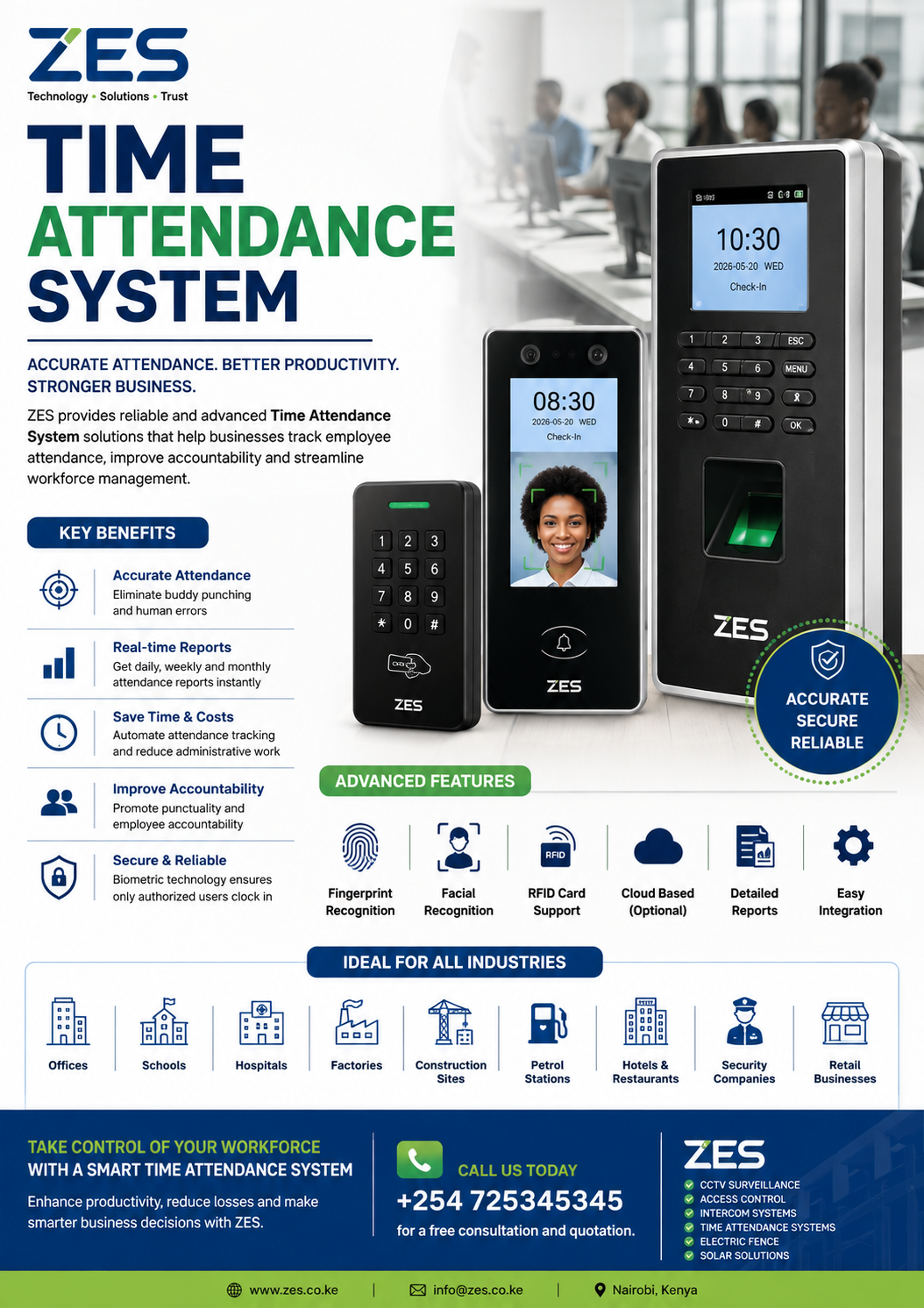
Managing employee attendance accurately is an important part of running a successful organization. Whether you operate a small business, factory, school, hospital, hotel, construction company, retail outlet, warehouse or organization with several branches, knowing when employees report to work and when they leave can have a major impact on productivity and payroll accuracy.
Traditional attendance registers are increasingly being replaced by automated Time Attendance Systems.
A modern Time Attendance System helps organizations record employee clock-in and clock-out times automatically. Depending on the solution installed, employees can identify themselves using fingerprints, facial recognition, RFID cards, PINs or other supported authentication methods.
For businesses in Kenya looking for a reliable Time Attendance System in Kenya, ZES provides solutions designed to improve attendance monitoring, employee accountability and workforce management.
A properly configured system can help your organization monitor lateness, absenteeism, overtime, working hours, shifts and employee attendance from a centralized platform.
What Is a Time Attendance System?
A Time Attendance System is an electronic solution used to record and manage when employees report to work, leave work and, depending on the configuration, take breaks or work overtime.
Instead of employees manually writing their names and arrival times in an attendance book, the process is automated.
For example, an employee arriving at the workplace may scan their fingerprint or face on a biometric attendance terminal.
The system records information such as:
- Employee identity
- Date
- Clock-in time
- Clock-out time
- Working hours
- Lateness
- Early departures
- Overtime
- Absence
- Shift information
The attendance information can then be accessed by authorized HR personnel, administrators or management.
Modern solutions can also integrate attendance information with payroll and HR systems, reducing the amount of manual work required when calculating employee working hours.
Why Businesses Need a Time Attendance System
Managing employees using attendance books or spreadsheets may appear inexpensive, especially for small businesses.
However, the process becomes increasingly difficult as the organization grows.
Imagine a company with 150 employees.
Every morning, employees write their arrival times in a book. At the end of the month, HR personnel must review hundreds or thousands of attendance entries.
They may then need to calculate:
- Days worked
- Days absent
- Late arrivals
- Overtime
- Early departures
- Leave days
- Total working hours
The process can consume significant administrative time.
A Time Attendance System automates much of this work.
Instead of calculating everything manually, attendance records are captured electronically and organized into reports that management can review.
How a Time Attendance System Works
Although implementations vary, most attendance systems follow several basic stages.
1. Employee Registration
Employees are first registered in the attendance system.
Information may include:
- Employee name
- Employee number
- Department
- Branch
- Job position
- Work schedule
- Shift
- Authentication method
If biometric identification is being used, the employee’s fingerprint or facial template is enrolled on the supported device.
2. Employee Clock-In
When an employee arrives at work, they verify their identity using the configured attendance method.
This may include:
- Fingerprint
- Facial recognition
- RFID card
- PIN
The attendance terminal records the transaction.
3. Attendance Data Is Stored
The system records the employee and time of the transaction.
Depending on the installation, information may be stored locally on the device, synchronized to attendance software or sent to a centralized server.
4. Employee Clock-Out
When leaving work, the employee clocks out again.
The system now has information that can be used to determine the employee’s attendance and working hours.
5. Attendance Reports Are Generated
Authorized administrators can review reports showing information such as attendance, lateness, absence and working hours.
This provides management with a clearer understanding of employee attendance patterns.
Types of Time Attendance Systems
Organizations have different attendance requirements. There is therefore no single solution that works perfectly for every business.
ZES can help businesses identify an appropriate solution based on their workforce, location, number of employees and operational requirements.
Some common types include the following.
Biometric Time Attendance System
A Biometric Time Attendance System identifies employees using biometric characteristics.
Fingerprint and facial recognition are among the most commonly deployed approaches.
Biometric attendance is particularly useful where businesses want to reduce situations where one employee records attendance on behalf of another.
Because biometric identification is associated with the registered employee, it provides a stronger identity verification method than a simple manual attendance register.
Fingerprint Time Attendance System
A Fingerprint Time Attendance System requires registered employees to scan their fingerprints when reporting to or leaving work.
The system verifies the employee and records the attendance transaction.
Fingerprint attendance machines are commonly used in:
- Offices
- Factories
- Warehouses
- Schools
- Hospitals
- Hotels
- Shops
- Construction businesses
- Institutions
They provide a simple method for organizations moving from manual attendance registers to electronic employee attendance management.
Face Recognition Attendance System
Facial recognition provides another method of recording attendance.
Employees stand in front of a compatible terminal, which verifies their registered facial template and records the attendance transaction.
Face recognition can be particularly useful for organizations that prefer a contactless attendance experience.
Depending on the selected hardware and software, facial recognition systems may also support other authentication methods.
RFID Card Attendance System
RFID attendance systems provide employees with registered cards that can be presented to a compatible reader.
When the card is presented, the system records the employee’s attendance transaction.
RFID can provide fast clocking for organizations with many employees entering within a short period.
However, organizations should establish proper card management procedures because physical cards can potentially be shared, misplaced or lost.
Cloud-Based Time Attendance System
Organizations with several offices or branches may need centralized attendance monitoring.
A cloud-connected attendance solution can make it easier for authorized managers to view attendance information from supported locations without depending entirely on a computer located at one branch.
This can be valuable for businesses operating branches in places such as Nairobi, Kiambu, Nakuru, Mombasa, Kisumu, Eldoret and other parts of Kenya.
Important Features of a Good Time Attendance System
Before purchasing a Time Attendance System in Kenya, businesses should evaluate the features they actually need.
Here are some of the most important capabilities to consider.
1. Employee Clock-In and Clock-Out
The basic purpose of an attendance system is accurately recording when employees arrive and leave.
A good solution should make these transactions easy for employees while giving management useful attendance records.
2. Biometric Identification
Biometric verification can help ensure that the person recording attendance is the registered employee.
Depending on the equipment selected, authentication may include fingerprint or facial recognition.
3. Shift Management
Not every employee works from 8:00 AM to 5:00 PM.
Businesses may operate:
- Morning shifts
- Evening shifts
- Night shifts
- Weekend shifts
- Rotating shifts
- Custom schedules
A suitable Time Attendance System should accommodate the organization’s shift structure.
This is especially important for factories, hospitals, hotels, security operations, manufacturing businesses and organizations operating beyond standard office hours.
4. Lateness Tracking
Repeated lateness can affect productivity.
An automated attendance system can make it easier for management to identify employees who regularly arrive after their scheduled reporting time.
Instead of relying on assumptions, HR can work from recorded attendance information.
5. Absence Management
The system can help identify employees who were expected at work but did not record attendance.
This makes it easier for HR teams to review attendance exceptions and determine whether the employee was absent, on approved leave or had another authorized reason.
6. Overtime Tracking
Organizations with overtime policies need reliable working-time information.
An attendance solution can help calculate hours recorded outside configured schedules according to the organization’s attendance rules.
This information can then be reviewed before payroll processing.
7. Attendance Reports
Reporting is one of the most valuable components of a modern attendance solution.
Depending on the software selected, organizations may generate:
- Daily attendance reports
- Weekly attendance reports
- Monthly attendance reports
- Late arrival reports
- Absentee reports
- Overtime reports
- Employee attendance reports
- Department reports
- Shift reports
- Clock-in and clock-out reports
These reports provide management with information for making workforce decisions.
8. Payroll Integration
Payroll preparation becomes more difficult when HR teams must manually calculate employee attendance every month.
A Time Attendance System with payroll integration can simplify this process.
Attendance information can be prepared for use by payroll systems to help determine factors such as working days, hours worked and approved overtime.
The exact integration depends on the attendance software and payroll platform being used.
Organizations should therefore discuss integration requirements before purchasing hardware.
9. Multi-Branch Attendance Management
Businesses with multiple branches often struggle to maintain consistent attendance records.
For example, a company may have employees working in Nairobi, Thika, Ruiru, Nakuru and Mombasa.
Instead of maintaining separate attendance books for every branch, compatible networked or cloud-based systems can centralize attendance information.
Management can then review employee attendance across different locations.
10. Employee Management
Attendance software can also maintain basic employee information.
Employees may be organized according to:
- Department
- Branch
- Position
- Shift
- Employee number
- Employment category
This makes attendance reporting easier for larger organizations.
Benefits of Installing a Time Attendance System
Installing a suitable Time Attendance System can provide several operational benefits.
Accurate Attendance Records
Manual attendance records can contain mistakes.
Employees may forget to sign in, enter the wrong time or produce handwriting that is difficult to interpret.
Electronic attendance provides standardized time records.
Reduced Buddy Punching
Buddy punching occurs when one employee records attendance for another employee.
Biometric authentication can significantly reduce this problem because attendance is linked to the registered person’s biometric identity.
Faster HR Administration
HR teams often spend considerable time compiling attendance information.
Automation reduces repetitive work and allows employees responsible for HR to focus on other responsibilities.
Better Payroll Preparation
Payroll depends on accurate information.
Where employee compensation is affected by working days, hours or overtime, reliable attendance data becomes particularly important.
Attendance software gives payroll administrators structured records that can be reviewed before salaries are processed.
Improved Employee Accountability
Employees are more likely to follow working schedules when attendance is recorded consistently.
Management can also address attendance issues using recorded information rather than relying only on assumptions.
Better Workforce Planning
Attendance reports can reveal useful patterns.
Management may discover that particular departments frequently experience lateness or that certain shifts regularly require overtime.
These insights can help businesses improve staffing and scheduling.
Easier Management of Large Teams
Manual attendance may be manageable with five employees.
It becomes much more complicated with 50, 200 or 1,000 employees.
Automated attendance systems provide businesses with a scalable method of managing attendance as their workforce expands.
Time Attendance System for Different Industries in Kenya
Different organizations can benefit from attendance automation.
Time Attendance System for Offices
Corporate offices can use attendance systems to track employee arrival and departure times.
HR departments can generate monthly reports and monitor attendance trends across departments.
Time Attendance System for Factories
Manufacturing environments often operate multiple shifts.
Factories may therefore require systems capable of handling:
- Multiple shifts
- Large employee numbers
- Overtime
- Night shifts
- Department reporting
- Centralized attendance records
Biometric attendance can provide an efficient way of handling these requirements.
Time Attendance System for Schools
Schools employ teachers, administrators, support employees, security personnel and other staff.
An employee attendance system can help school management maintain accurate staff attendance records.
Schools should distinguish between employee attendance management and student attendance requirements, as these may require different configurations.
Time Attendance System for Hospitals
Hospitals operate continuously and usually have complex shifts.
Doctors, nurses, administrators, laboratory staff, security teams and other employees may work different schedules.
A configurable attendance solution can help HR departments monitor these working arrangements.
Time Attendance System for Hotels
Hotels also operate around the clock.
Employees may work morning, afternoon and night shifts.
Attendance software can make it easier to manage these schedules while maintaining reliable clock-in and clock-out information.
Time Attendance System for Construction Companies
Construction businesses may have workers assigned to different sites.
Depending on connectivity and operational requirements, attendance solutions can be configured for specific sites or centralized monitoring.
A site assessment is particularly useful before selecting equipment for construction environments.
Time Attendance System for Retail Businesses
Supermarkets, shops and retail chains often employ workers across several shifts and branches.
A centralized attendance solution can help management monitor employee attendance across these locations.
Time Attendance System for Warehouses
Warehouses often require reliable employee attendance and access management.
Businesses may also consider integrating attendance with compatible access control infrastructure where appropriate.
Time Attendance System and Access Control
Time attendance and access control are related technologies, but they serve different primary purposes.
A Time Attendance System focuses on recording employee attendance and working times.
An Access Control System determines who is authorized to enter specific doors, rooms or facilities.
However, compatible systems can sometimes combine both functions.
For example, an employee may authenticate using a fingerprint or face at an entrance.
The system can verify whether the employee has access permission while also creating an attendance transaction where properly configured.
Organizations interested in combining these technologies should discuss their requirements during the site assessment.
Time Attendance System and CCTV Integration
Businesses investing in workplace security may use several complementary technologies.
These can include:
- CCTV surveillance
- Access control
- Biometric attendance
- Alarm systems
- Networking
- Intercom systems
While CCTV provides visual monitoring, attendance systems provide structured employee clocking records.
A properly planned security and workforce infrastructure can therefore combine different systems based on the organization’s requirements.
ZES can help organizations assess these needs and determine an appropriate implementation approach.
Choosing the Best Time Attendance System in Kenya
The best system is not necessarily the most expensive attendance machine.
It is the system that fits your organization.
Before purchasing, consider the following factors.
Number of Employees
How many employees will use the system?
A business with 15 employees has different requirements from a factory employing 1,500 people.
Ensure the selected hardware and software can support your current workforce while allowing reasonable room for growth.
Number of Locations
Do you operate from one office or several branches?
Multi-location businesses should consider whether attendance information needs to be centralized.
Authentication Method
Determine whether your organization prefers:
- Fingerprint
- Facial recognition
- RFID
- PIN
- Multiple authentication methods
The appropriate method depends on your working environment and security requirements.
Network Connectivity
Some attendance systems can transfer information using technologies such as:
- Ethernet/LAN
- Wi-Fi
- USB
- Internet/cloud connectivity
The available infrastructure at your premises should be considered before installation.
Payroll Requirements
If you need attendance information integrated with payroll, discuss this before purchasing the attendance machine.
Not every device automatically integrates with every payroll system.
Reporting Requirements
Consider the reports management needs.
For example:
- Monthly attendance
- Overtime
- Absenteeism
- Lateness
- Department attendance
- Branch attendance
- Individual employee records
Your reporting requirements can influence the software selected.
Support and Maintenance
Installation should not be the end of the project.
Organizations may require:
- User enrollment assistance
- Administrator training
- Software configuration
- Troubleshooting
- Device maintenance
- Network configuration
- Data backup guidance
Working with an experienced installer makes long-term system management easier.
Time Attendance System Installation Process
A professional installation normally involves several stages.
Step 1: Requirement Assessment
The installer first understands the organization’s needs.
Important questions include:
- How many employees do you have?
- How many branches are involved?
- What shifts do employees work?
- Do you need payroll integration?
- Do you need access control?
- Which attendance reports are required?
- Is network connectivity available?
Step 2: Site Survey
Where necessary, a technical site survey can determine:
- Suitable device locations
- Power availability
- Network availability
- Cabling requirements
- Mounting requirements
- Number of attendance terminals required
This helps prevent purchasing unsuitable equipment.
Step 3: Hardware Selection
The appropriate attendance terminal is selected based on the assessment.
The organization may choose fingerprint, face recognition, RFID or a combination depending on the required solution.
Step 4: Installation
The attendance machine is installed at the selected location.
Where network connectivity is required, appropriate configuration is completed.
Step 5: Software Configuration
Attendance rules can then be configured.
These may include:
- Departments
- Work schedules
- Shifts
- Reporting times
- Grace periods
- Overtime policies
- Holidays
Step 6: Employee Enrollment
Employees are registered on the system using the selected authentication method.
Step 7: Testing
The system should be tested before full deployment.
Tests can include:
- Employee clock-in
- Employee clock-out
- Device communication
- Attendance synchronization
- Shift calculations
- Report generation
Step 8: Administrator Training
HR personnel or system administrators should understand how to use the system.
Training may cover employee enrollment, reports, shift configuration and basic troubleshooting.
Biometric Time Attendance System Kenya
Biometric technology has become one of the most practical approaches to automated attendance.
A Biometric Time Attendance System in Kenya can help organizations replace paper registers with electronic identity verification and automated attendance records.
Depending on the selected device, organizations may use fingerprint or facial recognition.
Modern attendance platforms may also support features such as centralized monitoring, payroll exports, shift management and attendance reporting.
When selecting biometric equipment, businesses should avoid choosing a device based only on price.
Consider the complete solution:
Hardware + software + installation + configuration + training + support.
A cheap attendance machine that cannot produce the reports your HR department needs may become more expensive in the long term.
Time Attendance System for Small Businesses
Small businesses can benefit from attendance automation too.
You do not need hundreds of employees before implementing a Time Attendance System.
A business with 10, 20 or 30 employees may already experience challenges such as:
- Employees arriving late
- Manual attendance calculations
- Unclear overtime records
- Missing attendance information
- Difficulty preparing payroll
A simple biometric attendance setup may solve many of these challenges while allowing the organization to expand later.
Time Attendance System for Large Organizations
Large organizations have more complex requirements.
They may require:
- Multiple attendance devices
- Multiple branches
- Thousands of employee profiles
- Department structurer