
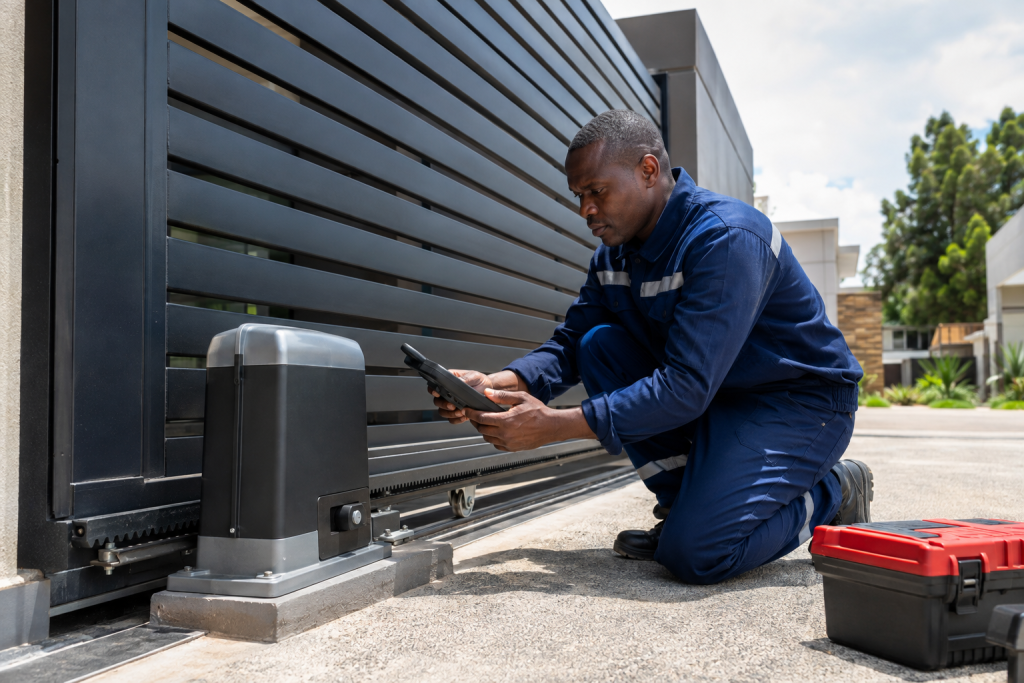
Choosing a sliding gate motor in Kenya should begin with the gate and the entrance—not the brand name printed on a motor box. Weight, friction, run-back space, daily traffic, drainage, power and safety all affect whether the finished system will operate reliably.
When a sliding gate is a good fit
A sliding gate can be practical where there is enough boundary length for the gate to move sideways and where opening leaves must not occupy the driveway. It is common at homes, apartments, offices and warehouses. The site still needs a clear travel path, stable support, suitable foundations and safe separation from people.
If the entrance lacks side space but has a level internal driveway, compare it with swing gate automation.
Start by testing the gate manually
Before motor selection, disengage any drive system and check how the gate moves by hand. It should travel smoothly without binding, lifting, scraping or requiring excessive force. Inspect wheels, bearings, guides, rack position, end stops, track alignment and the receiving area. A motor should not be used to overpower a mechanical defect.
Motor capacity and duty cycle
Motor ratings must be interpreted alongside the real gate weight and usage. A residential entrance that opens a few times each morning and evening is different from an apartment or logistics site with repeated peak-hour movements. Ask the installer to document the design assumptions, including estimated gate mass, travel distance and expected cycles.
- Gate mass: includes the fabricated structure and any cladding.
- Resistance: comes from track condition, wheels, slope and alignment.
- Wind exposure: matters for solid or heavily clad gates.
- Duty: reflects how often the gate operates and how closely cycles occur.
- Future use: apartments and businesses may add users or traffic over time.
Track-mounted and cantilever considerations
Many sliding gates run on wheels along a ground track. The track should be straight, firmly supported and planned so water, mud and debris do not constantly obstruct it. A cantilever arrangement avoids a ground track across the driveway but needs sufficient counterbalance length, structure and specialist foundation design. The appropriate configuration depends on the entrance.
Rack alignment and motor foundation
The toothed rack must engage the motor pinion correctly throughout the full travel. Poor alignment can produce noise, wear and intermittent movement. The motor base should be stable, appropriately elevated or drained for the site, and positioned for maintenance and manual release. Cables should be protected in suitable conduit rather than left exposed near moving parts.
Safety devices are part of the system
Photocells or other approved detection devices can help identify an obstruction, but they must be positioned, commissioned and tested for the actual entrance. Mechanical stops, control settings, warning indicators and a clear movement zone are also important. Pedestrians should use a separate route where practical instead of walking through a closing vehicle gate.
Backup power and manual release
For sites affected by outages, discuss battery backup performance in terms of expected cycles and battery condition—not just whether a battery exists. Users also need a controlled manual-release process and must know where the release key or mechanism is kept. At managed properties, this procedure should be included in staff handover.
Access options for a sliding gate
A sliding motor can receive commands from coded remotes, keypad, intercom, card reader, guard control or an approved access-management system. Compatibility and fail-safe behavior should be confirmed before equipment is purchased. Apartment and commercial properties should also decide how lost credentials, contractors and visitors will be handled.
Questions to ask in a quotation
- What measured gate weight and duty cycle was used for sizing?
- Are track, wheels, guides, stops and rack repairs included?
- Which safety devices and commissioning tests are included?
- What electrical, cabling, drainage or civil work is excluded?
- How will the system operate during an outage?
- What user training and documentation will be handed over?
Common causes of sliding gate trouble
Debris in the track, worn wheels, misaligned rack, unstable motor bases, water ingress, weak batteries, damaged safety sensors and uncontrolled manual force can all affect performance. If the gate becomes noisy, slow or inconsistent, stop repeated forcing and arrange inspection before damage increases.
Frequently asked questions
Can a heavy steel gate use a sliding motor?
Potentially, but the gate must be weighed or credibly estimated and the structure, wheels, guides, track and foundation assessed. Motor capacity is only one part of the design.
Can I use my phone to open the gate?
Some control arrangements support mobile or network-based credentials. Suitability depends on the selected controller, connectivity, user administration and security requirements.
How often should the system be serviced?
The interval should follow usage, site conditions and manufacturer guidance. A busy shared entrance normally needs more frequent inspection than a lightly used private home.
Plan the sliding system as a complete entrance
For broader planning, read the Gate Automation Kenya guide. To receive a site-based recommendation, request a ZES gate survey and quotation.