
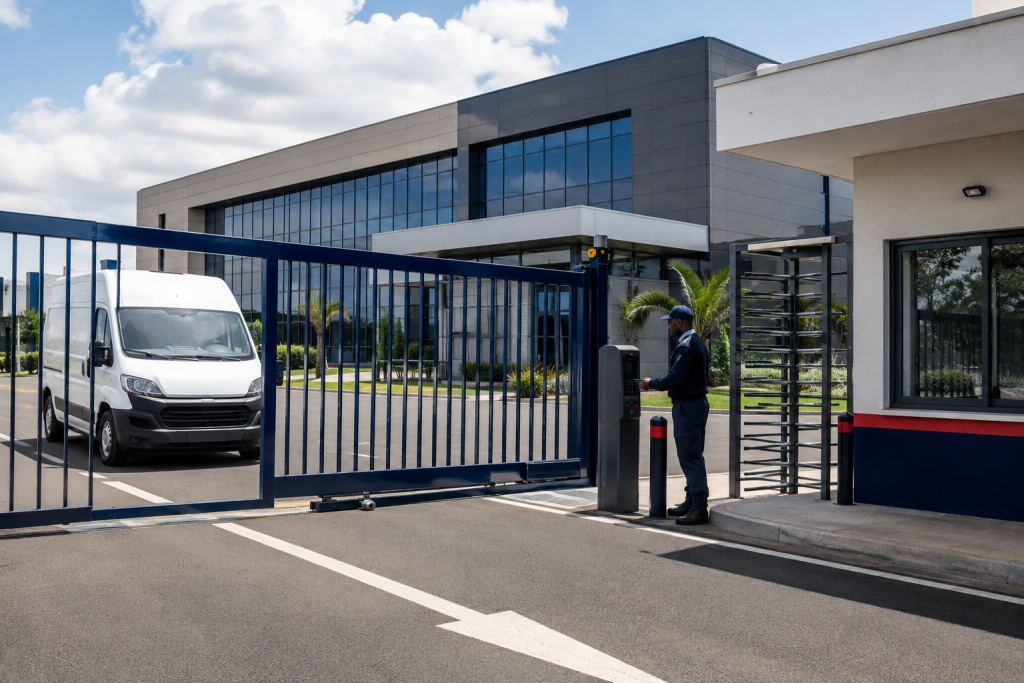
An automatic gate for commercial buildings must support real operations: staff arrival, visitors, suppliers, deliveries, shift changes and after-hours security. A system selected for appearance alone may struggle when commercial traffic and duty cycle increase.
Begin with traffic and operations
Document vehicle types, busiest periods, delivery windows, guard procedures and the available space for vehicles to wait without blocking a public road. Offices, warehouses, schools, hospitals and mixed-use compounds each need a different entrance plan.
Choose the gate configuration for the site
A sliding gate can suit a busy entrance when side run-back space is available. A swing gate may be appropriate for lower-volume sites with enough clear driveway depth. Barriers can manage vehicles quickly in some controlled environments but do not replace a perimeter gate where full closure is required. The final arrangement should reflect security and traffic needs.
Specify a realistic duty cycle
Commercial sites can produce concentrated cycles at shift start, lunch, dispatch periods and closing time. Motor sizing should use gate mass, friction, travel and peak cycles. The gate hardware, track, hinges, supports and power system must be designed for the same workload.
Accommodate delivery and service vehicles
Check entrance width, turning radius, gate opening speed, stopping positions and clearance for vans or trucks that actually use the property. Drivers need a safe place to present credentials or speak to security without leaving the vehicle in a dangerous position.
Keep pedestrian access separate
Staff and visitors on foot should not rely on walking through the vehicle gate. A controlled pedestrian gate, turnstile or reception path may be appropriate depending on the facility. Emergency egress and accessibility requirements must be reviewed as part of the wider building plan.
Connect access control thoughtfully
Commercial entrances may use cards, tags, intercom, guard authorization, approved mobile credentials or vehicle-recognition workflows. Define user roles, visitor approval, contractor expiry and what is recorded. See the dedicated Access Control Gate System guide for integration questions.
Safety and anti-tailgating are different problems
Obstacle detection helps reduce collision and trapping risk; it is not an anti-tailgating guarantee. Vehicle spacing, guard procedures, controlled credentials and site layout address unauthorized following. Do not make the gate close aggressively to solve a process problem.
Power and operational continuity
Define what the site should do during an outage: limited battery-backed cycles, generator-backed supply where compatible, controlled manual operation or another approved procedure. The design should protect equipment from local weather and power conditions, with accessible isolation and maintenance space.
What a commercial handover should include
- Equipment and credential register
- Normal, after-hours and visitor operating procedures
- Manual release and outage steps
- Commissioning results for safety and repeated cycles
- Fault reporting and service contacts
- Maintenance expectations based on traffic and environment
- Named responsibility for adding and revoking users
Prepare a decision-ready quotation brief
Provide gate dimensions and photos, property location, expected vehicles, peak cycles, delivery types, guard arrangement, pedestrian route, access method, power conditions and desired integrations. Ask bidders to list repairs, civil works, cabling, safety devices, credentials, training and exclusions.
Frequently asked questions
Can an automatic gate integrate with staff access cards?
Potentially, when the reader, controller and gate interface are compatible and the authorization workflow is designed correctly. Integration should be confirmed rather than assumed.
Is a faster gate always better?
No. Opening time must be balanced with gate type, safety, traffic control and manufacturer limits. Site geometry may have a greater effect on queues than speed alone.
Can one gate handle entry and exit?
It can at some sites, but traffic volume, visibility, waiting space and control logic must be assessed. Separate lanes may be better for a busy facility.
Plan a commercial gate around the business
Use the Gate Automation Kenya pillar for system fundamentals. Then request a ZES commercial entrance survey so the proposal reflects traffic, safety and access requirements.