
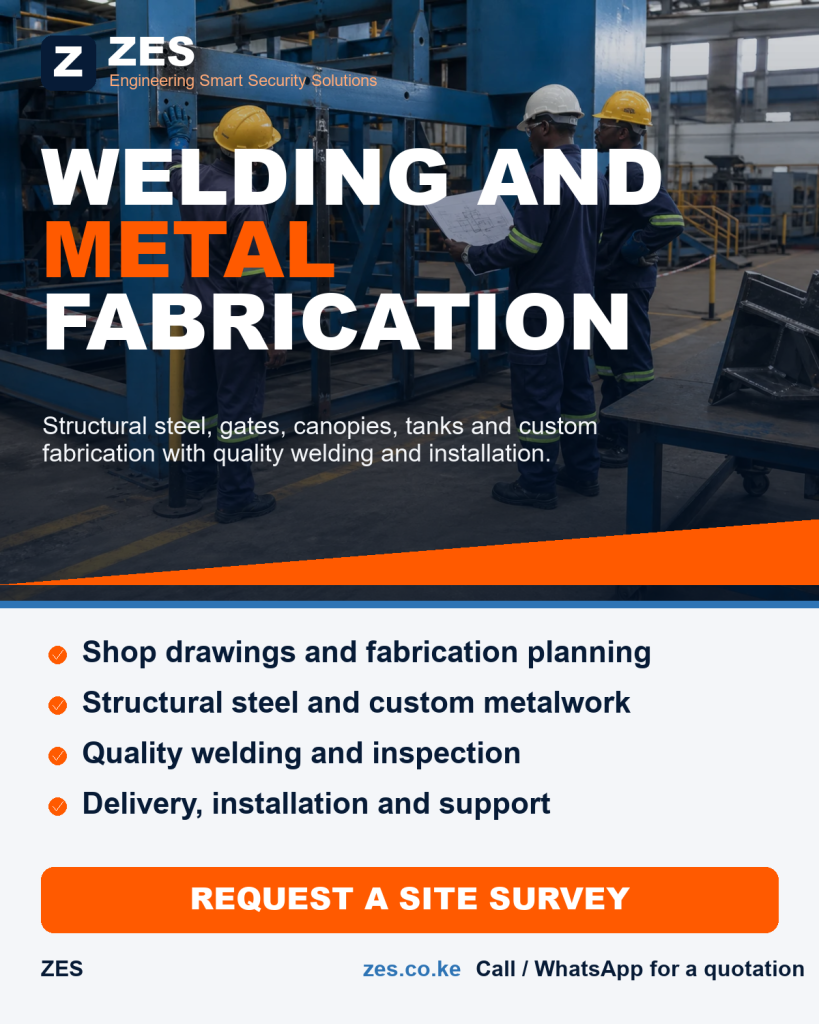
Welding and metal fabrication sit behind much of what makes a modern building, factory, warehouse or security installation work. Structural frames, canopies, staircases, gates, grilles, mezzanine floors, tanks, ducting, machine guards and mounting structures all depend on steel being cut, formed, welded and finished correctly.
In Kenya, demand for fabrication is strong and growing, driven by construction, warehousing, industrial expansion, security requirements and the growth of solar. But the market is broad, and the difference between a shop that can weld two pieces of metal together and a fabricator who can deliver an engineered, inspected, documented project is enormous.
This guide explains what professional welding and metal fabrication involves in Kenya, the processes and materials used, how quality is controlled, how safety is managed, what drives cost, and how to choose a fabricator who will deliver work that lasts.
It is written for developers, contractors, factory managers, architects, procurement teams and business owners who need fabrication work done properly.
Why Fabrication Demand Is Rising in Kenya
Several forces are driving demand for welding and metal fabrication.
Construction and warehousing. Warehouses, godowns, factories, malls and commercial buildings require structural steel, mezzanines, staircases, canopies and platforms.
Industrial expansion. Factories need tanks, silos, ducting, conveyors, guards, platforms and supports as they expand and upgrade.
Security requirements. Gates, grilles, strong-room structures, electric-fence posts and reinforced doors are fabricated products.
Solar growth. Solar carports, ground-mount structures and roof mounting systems require engineered steelwork.
Petrol and fuel infrastructure. Canopies, tank supports, walkways and structural steel are part of every station project.
Repair and maintenance. Existing structures need repair, modification and strengthening as they age or change use.
Import substitution. Local fabrication can be faster, more adaptable and easier to maintain than imported structures, especially for bespoke work.
The result is a market with real opportunity — and real risk for buyers who cannot tell good fabrication from bad.
Welding, Fabrication and Structural Steel: What Is the Difference?
These terms are often used interchangeably, but they describe different levels of work.
Welding is the joining process. It is a skill and a technique. On its own, it says nothing about design, engineering, inspection or project delivery.
Metal fabrication is the broader process of cutting, forming, assembling, welding and finishing metal into a product. It includes reading drawings, selecting materials, controlling dimensions, managing tolerances and delivering a finished item.
Structural steel is fabrication applied to load-bearing structures — frames, trusses, columns, beams and supports — where engineering, design and inspection are essential.
This distinction matters for buyers. A "welder" can repair a gate; a fabricator can deliver a warehouse structure with drawings, calculations, inspections and documentation. For projects worth millions, you need the latter.
Welding Processes Used in Kenya
Different processes suit different materials, thicknesses and quality requirements.
MIG/MAG (Gas Metal Arc Welding)
A continuous wire feed with shielding gas. It is fast, versatile and widely used for mild steel and aluminium. It suits production work and structural fabrication where speed and consistency matter.
TIG (Tungsten Inert Gas)
A precise process using a tungsten electrode and shielding gas. It is slower but produces clean, high-quality welds, particularly on stainless steel and aluminium. It is common in food-grade, architectural and thin-material work.
Stick Welding (Shielded Metal Arc Welding)
A manual process using a consumable electrode with a flux coating. It is robust, works outdoors and suits thicker material and site work where wind or conditions make gas-shielded processes difficult.
Spot Welding
Used for joining overlapping sheets, common in sheet-metal products and light fabrication.
Oxy-Acetylene Welding and Cutting
A traditional process used for cutting, heating, bending and some joining. It remains useful for site work and repair.
Plasma and Laser Cutting
Computer-controlled cutting produces accurate profiles, plates and components. Precision cutting improves fit-up and reduces assembly time.
The right process depends on the material, thickness, finish requirement, position and quality standard. A capable fabricator will select the process deliberately, not default to whatever is convenient.
What a Fabrication Shop Can Produce
A professional fabrication capability covers a wide range of products and structures.
Structural steel: columns, beams, trusses, purlins, bracing and frames for warehouses, factories, canopies and mezzanines.
Staircases and balustrades: internal and external stairs, fire escapes, handrails and guardrails.
Gates and grilles: security gates, sliding gates, pedestrian gates, window grilles, door grilles and strong-room structures.
Canopies and walkways: petrol station canopies, entrance canopies, walkway roofs and shelters.
Tanks and vessels: above-ground fuel tanks, water tanks, hoppers and storage vessels, subject to the required standards.
Ducting and ventilation: industrial ducting, extraction systems, hoods and supports.
Mezzanine floors and platforms: structural mezzanines, access platforms, walkways and equipment supports.
Solar structures: ground mounts, carports, roof frames and mounting systems.
Machine guards and frames: guards, skids, bases and equipment frames for factories.
Modular structures: site offices, security booths, kiosks and container modifications.
Repairs and strengthening: structural repairs, reinforcement, modification and refurbishment.
The breadth matters because it allows a fabricator to handle a complete package rather than fragmenting a project across several shops.
Materials and Their Behaviour
Material selection affects strength, durability, cost and finish.
Mild steel is the workhorse. It is strong, weldable, widely available and cost-effective, but it requires protection against corrosion.
Stainless steel resists corrosion and is used in food processing, hospitals, kitchens, coastal environments and architectural work. It requires different welding techniques and consumables to preserve corrosion resistance.
Aluminium is lightweight and corrosion-resistant, used in facades, windows, canopies and transport. It requires specific welding processes and skilled handling.
Galvanised steel is coated with zinc for corrosion protection. Welding galvanised steel requires care because of the coating, and welded areas need re-protection.
Coated and painted steel requires surface preparation before welding and refinishing afterwards.
A good fabricator will ask about the environment — coastal, industrial, food-grade, outdoor — because that determines the right material and finish.
Design, Drawings and Engineering
Fabrication should begin with design, not with cutting steel.
Shop drawings translate the design into fabrication instructions: dimensions, connections, weld symbols, material specifications and tolerances.
Structural calculations are required where the work is load-bearing. An engineer's involvement protects the client and ensures the structure is safe.
Coordination with other trades matters on construction sites. Steel must fit with civil works, electrical, plumbing and finishes.
Tolerances and fit-up determine whether components assemble correctly on site. Poor drawings cause expensive rework.
Approvals may be required for structural work, canopies or signage, depending on the project and the county.
A fabricator who cannot produce clear drawings and cannot explain the engineering basis of the work is not equipped for serious projects.
Quality Assurance and Inspection
Quality is what separates professional fabrication from improvisation.
Welding procedure specifications define how a joint should be welded: process, consumables, current, preparation and technique.
Welder qualification confirms that the welders can achieve the required standard for the material and position.
Material certificates confirm the grade and properties of the steel supplied.
Dimensional inspection checks that components match the drawings and tolerances.
Weld inspection may include visual inspection, dye penetrant, magnetic particle, ultrasonic or radiographic testing, depending on the criticality of the joint.
Fit-up and trial assembly catch problems before delivery to site.
Documentation records materials, inspections, tests and corrections.
For structural, pressure, lifting or safety-critical work, inspection is not optional. Buyers should ask what inspection will be performed and who will do it.
Safety in Welding and Fabrication
Fabrication carries real hazards, and safety management protects both workers and clients.
Hot work creates fire risk. Hot-work permits, fire watch, shielding and clearance of combustibles are essential, especially on site.
Fumes and ventilation matter. Welding fume extraction and adequate ventilation protect welders' health.
Personal protective equipment includes helmets, eye protection, gloves, aprons, respiratory protection and safety footwear.
Grinding and cutting produce sparks and flying particles, requiring guards and eye protection.
Working at height requires scaffolding, harnesses and safe access, especially during installation.
Lifting and handling heavy steel requires proper equipment and planning.
Confined spaces present additional hazards that require specific procedures.
Electrical safety is critical for welding equipment and site power.
A fabricator with a genuine safety culture will have procedures, permits and trained staff. Ask to see them for serious projects.
Workshop Fabrication versus Site Fabrication
Most fabrication is done in a workshop and then delivered to site, but some work happens on site.
Workshop fabrication offers controlled conditions, better equipment, consistent quality and safer working. It suits structural components, gates, canopies and repeatable items.
Site fabrication is used where components are too large to transport, where existing structures must be modified, or where site conditions require adjustment. It is more exposed to weather, access and safety constraints.
Site installation includes positioning, bolting, welding, alignment, grouting and finishing. It requires coordination with other trades and careful planning.
A good fabricator plans the split between workshop and site work deliberately, because it affects quality, cost and programme.
Corrosion Protection and Finishes
Steel in Kenya faces sun, rain, dust and, on the coast, salt. Protection is essential.
Surface preparation — cleaning, degreasing and removing rust — is the foundation of any finish.
Priming and painting provide a barrier against moisture. The number of coats and the paint system should suit the environment.
Galvanising provides excellent corrosion protection by coating the steel with zinc. It is common for outdoor and structural work.
Powder coating gives a durable, attractive finish for architectural and security products.
Stainless steel requires correct grade selection and passivation to maintain corrosion resistance.
Welded areas need re-protection after galvanising or coating is disturbed.
A fabricator who skips surface preparation or uses inadequate coatings is selling you a structure that will rust prematurely.
Installation and Site Works
Fabrication is only half the project. Installation determines whether the finished work looks right and performs as intended.
Site survey and measurement confirm dimensions and conditions before fabrication.
Delivery and logistics require planning for access, lifting and storage.
Alignment and levelling ensure structures sit correctly and doors, gates and stairs operate smoothly.
Bolted versus welded connections affect speed, adjustability and appearance.
Coordination with civil, electrical and finishing trades prevents conflicts.
Final inspection and handover confirm the work is complete, safe and to specification.
Poor installation can undermine good fabrication. Ask who will install, how, and under whose supervision.
What Affects Welding and Fabrication Cost in Kenya
Buyers often ask for a price per kilogram of steel. That is only part of the story.
Material grade and weight. Mild steel, stainless and aluminium vary widely in cost.
Design complexity. Simple frames cost less than intricate architectural work.
Welding process and quality requirements. Inspection, testing and higher standards add cost.
Fabrication hours. Skilled labour is a major component.
Finishing. Painting, galvanising and powder coating add cost.
Transport and site access. Remote sites and difficult access increase cost.
Installation. Site work, lifting and coordination add scope.
Engineering and drawings. Design and documentation are part of the value.
Programme. Urgent work may cost more.
A good quotation itemises material, fabrication, finishing, transport and installation so you can compare fairly. A suspiciously low price generally means thinner material, poor finishing or missing inspection.
How to Choose a Fabricator in Kenya
Use this checklist.
1. Do they ask for drawings or a site survey? Serious fabricators need to understand the work.
2. Can they produce shop drawings? Clear drawings prevent site problems.
3. Do they explain the engineering? Especially for load-bearing work.
4. Do they describe quality control? Welding procedures, inspection and material certificates.
5. Do they have a safety process? Hot-work permits, PPE and site procedures.
6. Do they explain finishing? Surface preparation, paint systems, galvanising or powder coating.
7. Do they install? Or hand over loose components for someone else to fit?
8. Can they show comparable work? Ask for projects in your sector.
9. Are they realistic about timelines? Good fabrication takes time.
10. Will they support the work after handover? Repairs, adjustments and maintenance.
Common Mistakes Buyers Make
Choosing by price per kilogram alone. It ignores design, quality and finishing.
No drawings. Fabrication without drawings invites errors and disputes.
Under-specifying material. Thinner or lower-grade steel saves money and fails sooner.
Ignoring corrosion protection. Unprotected steel rusts quickly in Kenya's climate.
Skipping inspection. Weld defects may not be visible until failure.
Poor site measurement. Components that do not fit cause expensive rework.
No safety planning. Hot work and working at height are serious hazards.
Unrealistic timelines. Rushed fabrication compromises quality.
No maintenance plan. Steel structures need periodic inspection and repainting.
Fabrication by Sector
Warehouses and godowns: structural frames, mezzanines, racking supports, canopies and gates.
Factories: platforms, guards, ducting, tanks, supports and machine frames.
Commercial buildings: staircases, balustrades, canopies, facades and architectural steel.
Petrol stations: canopies, walkways, tank supports and structural steel.
Schools and institutions: gates, grilles, canopies, covered walkways and security structures.
Hospitals: stainless steel work, guardrails, canopies and equipment supports.
Estates and homes: gates, grilles, staircases, balustrades and carport structures.
Solar projects: ground mounts, carports and roof mounting structures.
Telecom and industrial sites: towers, supports, shelters and platforms.
Maintenance and Repair
Fabricated steel is durable but not maintenance-free.
Inspection should look for rust, loose connections, cracked welds, deformation and coating failure.
Repainting protects steel and extends its life, especially in coastal and industrial environments.
Repairs may include rewelding, strengthening, replacing components or correcting alignment.
Modifications are common when a building changes use or equipment changes.
Documentation of the original fabrication helps future maintenance.
A fabricator who offers inspection, repair and maintenance protects the investment they delivered.
Welding Quality: What Good and Bad Welds Look Like
You do not need to be a welder to spot warning signs, though a proper inspection is always better than visual judgement.
A good weld is consistent in width and profile, sits correctly in the joint, shows no visible cracks, undercut or excessive spatter, and transitions smoothly into the parent metal. The surrounding area is clean, and the weld has clearly been made with the right process and settings for the material.
Warning signs include uneven bead width, deep undercut along the edges, porosity visible as small holes, slag trapped in the weld, excessive spatter, burn-through on thin material, and welds that look like they were rushed or heavily ground to hide defects. Grinding a weld smooth is sometimes legitimate for appearance, but heavy grinding can also hide problems.
For structural and safety-critical work, visual inspection is only the first layer. Non-destructive testing can detect defects that cannot be seen, such as internal cracks or lack of fusion. Ask what testing will be performed and who will witness it.
Quality also shows in the details: consistent fit-up, clean edges, correct hole positions, square frames, tidy cable management on fabricated equipment and proper treatment of welds before finishing. Sloppy preparation almost always leads to sloppy results.
Structural Steel versus Light Fabrication: Different Standards
Not all fabrication carries the same risk, and it helps to understand the difference.
Light fabrication covers gates, grilles, sign frames, small guards, furniture and decorative items. The loads are modest, and the consequences of failure are usually limited. Quality still matters for durability and appearance, but the engineering requirements are lighter.
Structural fabrication covers frames, trusses, columns, beams, mezzanines, canopies, platforms and load-bearing supports. Here, failure can injure people or collapse a building. Structural work requires engineering design, calculations, proper connections, qualified welders, inspection and documentation.
Pressure and special applications include tanks, vessels and equipment that may be subject to specific standards and testing. These require specialist competence and should not be treated as ordinary fabrication.
Buyers should be clear about which category their project falls into and choose a fabricator with the corresponding capability. A shop that is excellent at gates may not be equipped for a warehouse structure, and a structural fabricator may not be the most economical choice for small decorative work.
Choosing the Right Finish
Finish selection is a balance of protection, appearance and cost.
Primer and paint are the most common finish. A suitable primer and a minimum number of topcoats protect against moisture and provide colour. The paint system should match the environment — a coastal site needs more protection than an indoor office.
Galvanising immerses the steel in molten zinc, creating a metallurgical bond that protects against corrosion for many years. It is excellent for outdoor structures, canopies, frames and gates. Welded areas and cut edges are protected by the zinc, though very large structures may need to be designed for galvanising bath size.
Powder coating applies a dry powder that is cured to form a durable, attractive finish. It suits architectural and security products where appearance matters, but it requires proper surface preparation and is less suitable for site repairs.
Stainless steel relies on its alloy composition for corrosion resistance. Correct grade selection, careful welding and passivation are essential, especially in coastal or hygienic environments.
Combination systems — such as galvanising plus powder coating — offer strong protection and a quality finish, at higher cost.
The key question is not which finish looks best today, but which will still be protecting the steel in five or ten years.
Managing a Fabrication Project
Fabrication projects run more smoothly when the client manages a few basics.
Define the scope clearly. Drawings, specifications, finishes, quantities and installation responsibilities should be agreed before work starts.
Confirm site readiness. Foundations, access, power and storage should be ready when components arrive.
Coordinate with other trades. Steelwork must fit with civil works, electrical, plumbing and finishes.
Agree inspection points. Hold points for fit-up, welding inspection and finishing prevent surprises.
Track the programme. Material lead times, fabrication and installation should be scheduled realistically.
Manage variations. Changes after fabrication starts are expensive; document them clearly.
Plan delivery and lifting. Large components require access, equipment and coordination.
Prepare for handover. Documentation, as-built drawings and maintenance information should be part of the package.
Clients who invest a little time in coordination usually save far more in avoided rework.
Emerging Demand: Solar Structures and Industrial Fabrication
Two areas are growing quickly and are worth highlighting.
Solar mounting structures. The growth of commercial and residential solar has created demand for carports, ground mounts, roof frames and elevated structures. These must be engineered for wind loads, corrosion and the weight of the panels, and they must integrate with the electrical installation.
Industrial fabrication. Factories expanding or upgrading need platforms, guards, ducting, tanks, supports and machine frames. This work requires an understanding of the production environment, safety requirements and the need to minimise downtime.
Both areas reward fabricators who can combine engineering, fabrication and installation. They also illustrate why the "welding" label understates the value of good fabrication: the client is not buying welds, but a structure that performs safely for years.
Repairs, Modifications and Strengthening
Not every fabrication project is new-build. Much of the work in Kenya involves repairing, modifying or strengthening existing steel structures.
Repairs address damage from impact, corrosion, fatigue or poor original work. They require inspection to understand the cause and to ensure the repair restores the required strength.
Modifications adapt structures for new equipment, changes of use or expansion. They must consider the original design and the effect of the change on the whole structure.
Strengthening increases capacity where loads have increased or the original design is inadequate. It requires engineering input and careful welding to avoid introducing new weaknesses.
Corrosion treatment is often part of repair work, especially on coastal sites or older structures.
The risk in repair and modification work is that it is treated casually. A repair that looks fine but does not restore structural capacity can be worse than no repair. Ask for inspection, engineering advice where needed, and documentation of what was done.
Frequently Asked Questions
What is the difference between welding and metal fabrication?
Welding is the joining process. Metal fabrication is the broader process of designing, cutting, forming, assembling, welding and finishing metal into a product. Structural steel fabrication adds engineering and inspection for load-bearing work.
How much does metal fabrication cost in Kenya?
Cost depends on material, weight, complexity, welding and inspection requirements, finishing, transport and installation. Request an itemised quotation based on drawings or a site survey.
Do I need engineering drawings?
For structural or load-bearing work, yes. Drawings and calculations ensure safety and correct fit. For simple items, a detailed sketch and specification may be enough.
What welding process will be used?
It depends on the material and application. MIG, TIG, stick welding and other processes each suit different situations. A good fabricator will explain the choice.
How is weld quality checked?
Through welding procedures, qualified welders, visual inspection and, where required, non-destructive testing such as dye penetrant, magnetic particle, ultrasonic or radiographic inspection.
What finish should I choose?
It depends on the environment. Painting suits many indoor applications; galvanising and powder coating offer better protection outdoors and in coastal areas; stainless steel suits corrosive or hygienic environments.
Can you fabricate and install?
A complete fabricator can design, fabricate, deliver and install, which reduces coordination risk. Confirm who is responsible for installation and site safety.
How long does fabrication take?
Simple items can take days; structural packages can take weeks. Timelines depend on design, material availability, workshop capacity and site readiness.
Can you repair existing steel structures?
Yes. Repairs, strengthening and modifications are common, but they require inspection and, for structural work, engineering input.
Do you work outside Nairobi?
Yes. Delivery and installation can be arranged across Kenya, with logistics reflected in the quotation.
A Final Pre-Purchase Checklist
Before awarding a fabrication contract, confirm the following. Make sure drawings or a site survey are complete. Check that the quotation itemises material grade, weight, fabrication, finishing, transport and installation. Confirm the welding processes and quality-control arrangements. Ask what inspection and testing will be performed. Confirm the finish and its suitability for the environment. Ask who is responsible for installation and site safety. Request examples of comparable work. Confirm the programme and payment terms. Ask how the work will be documented and supported after handover. Finally, compare quotations against the same specification, not just the same headline number.
A fabricator who answers these questions clearly is usually the one worth trusting with structural work.
Conclusion
Welding and metal fabrication in Kenya is a skilled engineering service, not a commodity. The difference between work that lasts and work that fails is the design, the material selection, the welding quality, the inspection, the finishing, the installation and the support that follows.
If you are planning a fabrication project, start with the drawings and the environment: what the structure must do, what material suits it, how it will be protected and how it will be installed. Then insist on a proper quotation, a quality plan, a safety plan and documentation.
It also helps to think beyond the immediate project. A well-fabricated structure is an asset that can be inspected, maintained, modified and extended over many years. A poorly fabricated one becomes a recurring cost — repainting, repairing, strengthening and eventually replacing. The cheapest quotation is rarely the cheapest outcome, and the difference is almost always decided before the first weld is made.
ZES provides welding, metal fabrication, structural steel and installation for warehouses, factories, commercial buildings, petrol stations, estates and institutions across Kenya. If you would like a practical assessment and a clear, itemised quotation, start with a site survey.
Request a fabrication site survey and quotation from ZES
Related Welding Services
Explore the rest of our welding and fabrication capability: