
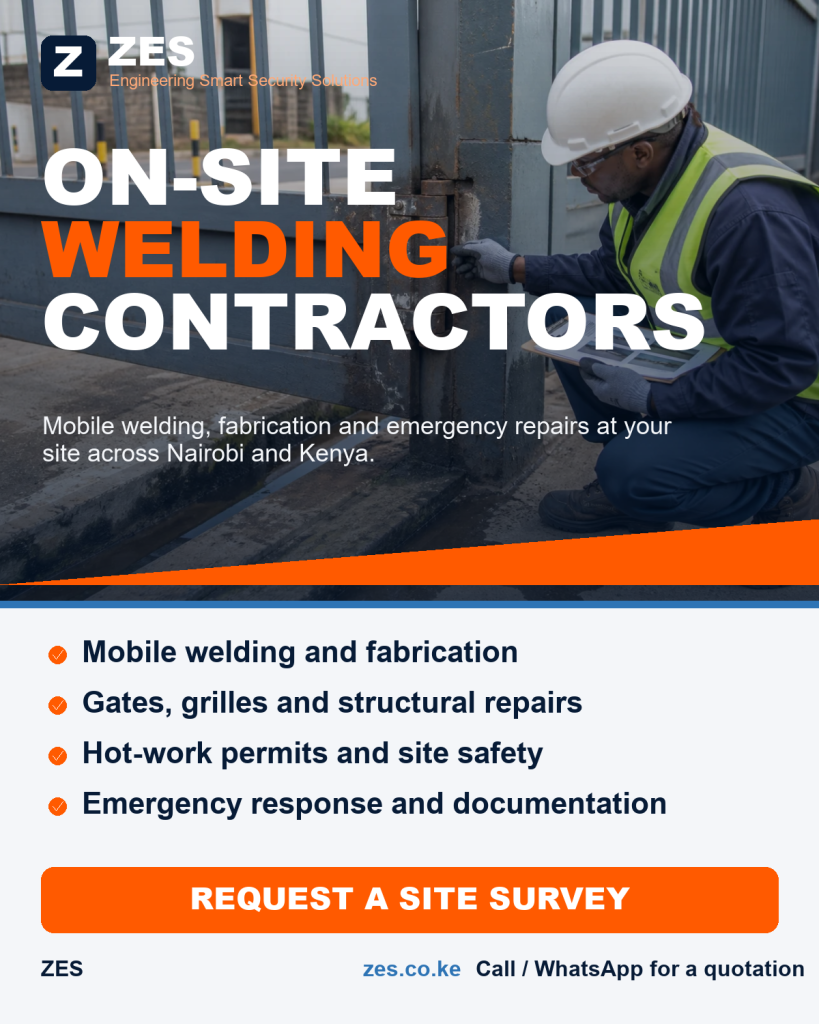
Not every welding job can be done in a workshop. Gates seize, structures crack, equipment fails, railings loosen and modifications are needed where the item is installed. Moving the item is often impossible, impractical or too slow. That is when on-site welding contractors are needed.
Arrange an on-site welding assessment
For a ZES quotation, share site location, photographs, dimensions, power availability, access restrictions, hot-work arrangements and preferred working window. The team can then confirm the assessment, fabrication, site work and supporting specialists required for your project.
Ask the written proposal to identify materials, quantities, preparation, finishing, installation, inspection, exclusions and handover records. Any required welder qualifications, specialist tests or compliance documents must be confirmed for the actual scope before appointment.
On-site welding contractors bring welding and fabrication to the client's location. They work in factories, warehouses, schools, hospitals, offices, estates, construction sites and homes. They repair gates and grilles, weld structural repairs, modify equipment, install fabricated components and respond to emergencies.
This guide explains what on-site welding involves, when it is needed, the equipment and skills required, how site conditions affect the work, how safety and permits are managed, how quality is maintained outside a workshop, what affects cost, and how to choose a contractor in Nairobi and across Kenya.
It is written for facilities managers, property managers, factory maintenance teams, contractors, school administrators and business owners.
What On-Site Welding Is
On-site welding is welding performed at the location where the work is needed, rather than in a workshop.
It includes:
Repairs. Welding cracked gates, grilles, railings, frames and structures.
Modifications. Altering existing structures or equipment in place.
Installation. Welding components during installation.
Fabrication. Making or fitting parts on site where transport is impractical.
Emergency response. Temporary or permanent repairs after failures.
Maintenance. Scheduled welding maintenance at the site.
On-site work requires portable equipment, careful planning and strong safety discipline.
When On-Site Welding Is Needed
Several situations call for on-site work.
Large or fixed items. Gates, structures, tanks and machinery that cannot be moved.
Structural connections. Site connections during construction or modification.
Urgent repairs. Failures that must be fixed immediately.
Access constraints. Items installed in places where removal is difficult.
Modifications in place. Changes to existing structures or equipment.
Installation support. Welding during equipment or structure installation.
Remote sites. Locations where workshop access is limited.
On-site welding avoids transport and downtime but introduces site risks.
What On-Site Contractors Do
On-site welding contractors provide a range of services.
Gate and grille repair. Hinges, frames, locks and alignment.
Structural repair. Cracked frames, supports and connections.
Equipment repair. Frames, guards, stands and components.
Fabrication on site. Cutting, fitting and welding where needed.
Installation welding. Connecting fabricated components.
Modification. Adapting structures and equipment.
Emergency repairs. Temporary and permanent fixes.
Maintenance. Scheduled on-site welding.
Inspection and advice. Assessing what needs repair.
A capable contractor arrives prepared for the site conditions.
Equipment and Mobilisation
On-site work depends on the right equipment.
Welding machines. Engine-driven or inverter welders suitable for site power.
Cutting equipment. Angle grinders, plasma cutters or gas cutting.
Power. Generators or site power, with safe connections.
Gas. Shielding gas and cylinders, stored and transported safely.
Tools. Clamps, hammers, squares, measuring tools and PPE.
Materials. Consumables and common steel sections.
Transport. Vehicle suitable for equipment and materials.
Lighting. For work in poorly lit areas.
Access equipment. Ladders, scaffolding or platforms.
Mobilisation affects response time and cost.
Site Assessment
Every on-site job begins with assessment.
What needs to be done? Repair, modification, installation or fabrication.
What is the material? Steel type and condition.
What is the access? Distance, stairs, height and obstructions.
What is the power supply? Available or generator required.
What are the hazards? Fire, height, confined space, chemicals, traffic.
What are the restrictions? Working hours, noise, permits and access control.
What is the environment? Indoor, outdoor, weather exposure.
What is the urgency? Emergency or planned.
What is the expected outcome? Function, safety and appearance.
Good assessment prevents surprises on site.
Safety and Permits
On-site welding carries serious hazards.
Hot work permits. Required in many facilities.
Fire watch. Trained personnel and equipment during and after work.
Clearance of combustibles. Remove or protect flammable materials.
Ventilation. For indoor and confined spaces.
PPE. Helmets, eye protection, gloves, aprons and respiratory protection.
Working at height. Safe access and fall protection.
Electrical safety. Safe power connections and isolation.
Site induction. Understanding site rules and hazards.
Emergency procedures. Clear response arrangements.
Insurance. Adequate cover for site work.
Safety is non-negotiable on site.
Working in Occupied Sites
Many on-site jobs happen where people are present.
Scheduling. Work around operating hours, school terms or clinic hours.
Screens and barriers. Protect people from sparks, fumes and noise.
Access control. Keep the public and staff away from the work area.
Cleaning. Clean up debris and metal particles.
Communication. Inform occupants about timing and restrictions.
Noise. Minimise disturbance where possible.
Safety. Protect occupants from tools, hot work and falling objects.
Sign-off. Confirm the area is safe before leaving.
Working in occupied sites requires care and discipline.
Weather and Environment
Outdoor work is affected by weather.
Wind. Affects welding quality and safety, especially gas-shielded processes.
Rain. Can affect welding and electrical safety.
Heat and sun. Affects workers and materials.
Dust. Affects weld quality and worker health.
Humidity. Affects some processes and materials.
Site conditions. Mud, uneven ground and access.
Planning. Schedule work around weather where possible.
Protection. Shelters and covers where needed.
Weather planning improves quality and safety.
Quality on Site
Site work can achieve workshop quality with discipline.
Preparation. Clean surfaces and proper fit-up.
Process selection. Suit the material and conditions.
Heat control. Avoid distortion and property changes.
Welding technique. Qualified welders and procedures.
Finishing. Grinding, cleaning and protection.
Inspection. Visual and, where required, NDT.
Protection. Paint or treatment after welding.
Documentation. Record the work.
Site conditions make quality harder, not impossible.
Emergency and Breakdown Response
On-site contractors often respond to emergencies.
Fast mobilisation. Availability and equipment readiness.
Assessment. Identify the failure and the safest temporary solution.
Temporary repair. Secure the situation and restore safe operation.
Permanent repair. Plan and execute a durable fix.
Root cause. Understand why the failure occurred.
Communication. Keep the client informed.
Documentation. Record the repair and recommendations.
Emergency capability is valuable, but planned maintenance is better.
What Affects On-Site Welding Cost
Cost depends on the job and conditions.
Type of work. Simple repairs cost less than fabrication.
Access. Distance, height and obstructions increase cost.
Mobilisation. Travel and equipment transport.
Power. Generator hire where site power is unavailable.
Materials. Steel, consumables and gas.
Safety requirements. Permits, fire watch and access equipment.
Urgency. Emergency and after-hours work costs more.
Duration. Longer jobs increase labour and equipment costs.
Documentation. Reports add value.
A clear quotation explains what is included.
How to Choose an On-Site Welding Contractor
Use this checklist.
1. Are they mobile and equipped? Portable welders, tools and materials.
2. Do they assess the site? Access, hazards and conditions.
3. Are they safe? Permits, PPE and site discipline.
4. Do they provide quality work? Preparation, technique and finishing.
5. Can they respond quickly? For emergencies.
6. Do they provide documentation? Records and reports.
7. Do they have relevant experience? Similar sites and work.
8. Are they insured? Site work requires cover.
9. Do they clean up? Leaving the site safe and tidy.
10. Do they offer maintenance? Ongoing support.
Common Mistakes in On-Site Welding
No site assessment. Surprises and delays.
No permits. Safety and compliance issues.
Poor protection. Damage to property and contamination.
Inadequate power. Poor welds or equipment failure.
No fire watch. Fire risk during and after hot work.
Poor finishing. Corrosion and appearance problems.
No cleaning. Metal particles and debris left behind.
No documentation. Difficult to track and warrant.
Choosing only on price. Cheap work costs more over time.
On-Site Welding by Sector
Factories: equipment frames, guards and structural repairs.
Warehouses: racking, gates and structural repairs.
Schools: gates, grilles, desks and playground equipment.
Hospitals: security structures, equipment supports and maintenance.
Offices: gates, railings and architectural repairs.
Estates and homes: gates, grilles, fences and carports.
Construction sites: structural connections and installation.
Petrol stations: canopies, supports and security structures.
Each sector has specific requirements, and a good contractor adapts.
Portable Welding Equipment Explained
On-site work depends on portable, reliable equipment.
Inverter welders. Lightweight and efficient, often suitable for site work.
Engine-driven welders. Independent of site power, useful in remote locations.
MIG/MAG sets. For faster welding of thinner materials.
TIG sets. For precise work on stainless and thin sections.
Plasma cutters. For clean cutting of steel.
Angle grinders. For cutting, grinding and finishing.
Gas cutting equipment. For thicker steel and demolition.
Generators. For power where site supply is unavailable.
Cables and leads. Sized for the current and distance.
PPE and screens. For worker and occupant safety.
Equipment must be maintained and suitable for the job.
Site Power and Generator Safety
Power is a common site issue.
Site supply. Confirm capacity and safety before connecting.
Generators. Sized for the welding equipment and other tools.
Earthing. Proper earthing of equipment and generators.
Cable protection. Avoid damage from traffic and sharp edges.
Isolation. Safe connection and disconnection.
Weather protection. Keep connections dry.
Fuel storage. Safe storage and handling.
Ventilation. Generators must not be run in enclosed spaces.
Inspection. Check equipment before use.
Power problems cause poor welds and safety incidents.
Working at Height on Site
Many on-site jobs involve height.
Risk assessment. Identify the height, access and hazards.
Access equipment. Ladders, scaffolds, mobile towers or lifts.
Fall protection. Harnesses and anchor points where required.
Tool security. Prevent dropped tools and materials.
Exclusion zones. Keep people below the work area.
Weather. Wind and rain affect height work.
Training. Competent workers for height work.
Rescue plan. For fall arrest situations.
Height work is a leading cause of serious injury on site.
Gate and Grille Repair on Site
Gates and grilles are among the most common on-site jobs.
Hinge repair. Worn or broken hinges cause sagging and misalignment.
Frame repair. Cracked or bent frames need straightening or reinforcement.
Lock and latch repair. Alignment affects security and function.
Wheel and track repair. Sliding gates need smooth operation.
Rust treatment. Cleaning and repainting extend life.
Alignment. Gates should open and close smoothly.
Security. Repairs must not weaken the gate.
Testing. Operate the gate through its full range.
A gate that is welded but misaligned will fail again.
Structural Repair on Site
Structural repairs require care.
Assessment. Understand the member, load and failure.
Engineering input. For load-bearing repairs.
Temporary support. Keep the structure stable during work.
Preparation. Clean and prepare the repair area.
Welding. Qualified procedures and welders.
Reinforcement. Add material where required.
Inspection. Verify the repair.
Protection. Repaint or treat the repaired area.
Documentation. Record the work.
Structural repairs without engineering can be dangerous.
Site Reporting and Handover
Reporting protects both parties.
Scope completed. What was done.
Materials used. Steel, consumables and finishes.
Testing. Results of inspections or tests.
Photos. Before, during and after.
Recommendations. Follow-up and prevention.
Warranty. Coverage and terms.
Sign-off. Client acceptance.
Asset record. Update maintenance history.
Good reporting supports maintenance and future work.
Building a Mobile Maintenance Arrangement
Regular on-site needs benefit from an arrangement.
Agreed rates. For common tasks.
Response times. For emergencies.
Scheduled visits. For inspections and maintenance.
Priority. For critical assets.
Reporting. Standard reports.
Continuity. Same contractor familiar with the site.
Safety. Familiarity with site rules and hazards.
Budgeting. Predictable costs.
A mobile maintenance arrangement reduces surprises.
Site Access and Logistics
Access affects time and cost.
Vehicle access. Can the contractor reach the work area?
Distance from parking. Long carries increase labour.
Stairs and lifts. Equipment and materials must be moved safely.
Door widths. Large items may not fit through.
Ground conditions. Mud and uneven ground affect equipment.
Permits. Site access and parking permissions.
Storage. Secure storage for tools and materials.
Waste removal. Removing debris and offcuts.
Planning. Agree access arrangements before the day.
Poor access planning wastes time and frustrates clients.
Working in Confined Spaces
Some on-site welding happens in confined spaces.
Definition. Tanks, pits, ducts and enclosed areas with limited access.
Hazards. Poor ventilation, toxic gases, fire and entrapment.
Gas testing. Before entry and during work.
Ventilation. Forced ventilation for welding fumes.
Attendant. Someone outside the space at all times.
Rescue plan. Equipment and procedures for rescue.
Permits. Confined space entry permits.
PPE. Appropriate to the hazards.
Training. Competent workers.
Confined space work is high-risk and must be planned.
Protecting Property During On-Site Work
On-site work can damage property.
Screens and blankets. Protect surfaces from sparks and spatter.
Floor protection. Cover floors and prevent damage.
Dust control. Contain grinding dust.
Water damage. Avoid water where it can damage property.
Landscaping. Protect plants and paving.
Signage. Warn occupants of hazards.
Cleaning. Remove debris and marks.
Inspection. Check for damage before leaving.
Compensation. Agree responsibility for damage.
Protecting property protects the client relationship.
Quality Welding in Outdoor Conditions
Outdoor conditions affect quality.
Wind. Disrupts shielding gas; use screens or appropriate processes.
Rain. Stop welding or protect the work.
Humidity. Affects some processes and materials.
Temperature. Extreme cold or heat affects welding.
Dust. Contaminates welds.
Preparation. Clean surfaces before welding.
Process selection. Choose processes suited to conditions.
Inspection. Check welds carefully.
Protection. Coat repaired areas promptly.
Outdoor welding requires discipline to achieve quality.
Cost Planning for On-Site Work
On-site costs differ from workshop costs.
Mobilisation. Travel and equipment transport.
Labour. Travel time and site conditions.
Materials. Steel, consumables and gas.
Equipment. Generator hire and tool wear.
Safety. Permits, fire watch and access equipment.
Duration. Longer jobs increase costs.
Urgency. Emergency and after-hours premiums.
Documentation. Reports and records.
Comparison. Compare on scope, not just hourly rate.
A clear quotation avoids surprises.
When to Move the Job to a Workshop
Not everything should be done on site.
Complex fabrication. Better in a workshop with equipment.
Precision work. Controlled conditions improve quality.
Finishing. Polishing and passivation are easier in a workshop.
Large assemblies. Shop assembly and trial fit reduce site problems.
Cost. Workshop work can be cheaper for large jobs.
Downtime. Removing an item may be faster than on-site work.
Quality. Workshop conditions are more reliable.
Decision. Balance access, quality, cost and downtime.
A good contractor will recommend the right approach.
Frequently Asked Questions
What is on-site welding?
Welding performed at the client's location rather than in a workshop, used for repairs, modifications, installation and fabrication where items cannot be moved.
When should I use an on-site welding contractor?
When the item is fixed, too large to move, urgently needed, or located where removal is impractical.
Do you bring your own equipment?
Yes. Portable welders, cutting equipment, tools, materials and safety equipment are mobilised to site.
Can you work in occupied buildings?
Yes, with planning, screening, access control and cleaning. Work is scheduled around occupants where possible.
Do you provide hot work permits?
The contractor should work within the site's permit system. In facilities without a system, fire precautions and a fire watch are essential.
Can you respond to emergencies?
Emergency response can be arranged, subject to availability.
How long does on-site work take?
It depends on the job. Simple repairs may take hours; larger work may take days.
Do you provide documentation?
Yes. Records, reports and recommendations can be provided.
Do you work outside Nairobi?
Yes. On-site services can be provided across Kenya.
Can you do temporary repairs?
Yes, where necessary. Temporary repairs should be followed by permanent repairs.
A Final Pre-Purchase Checklist
Before engaging an on-site welding contractor, confirm the following. Make sure they assess the site and access. Check their equipment and mobilisation. Confirm safety arrangements and permits. Ask about quality and finishing. Confirm cleaning and protection of the site. Ask about documentation. Confirm emergency capability. Ask for references. Finally, compare quotations against the same scope and conditions.
A contractor who explains these points clearly is usually the one worth trusting on site.
Conclusion
On-site welding contractors in Nairobi bring welding and fabrication to where the work is needed. The difference between a safe, durable repair and a recurring problem is the assessment, the equipment, the safety discipline, the quality of work and the follow-up.
If you need on-site welding, start with a clear description of the problem and the site conditions. Then insist on a proper assessment, safe working practices and quality finishing.
ZES provides on-site welding, fabrication, repair and maintenance for factories, institutions, estates and commercial properties in Nairobi and across Kenya. If you would like a practical assessment and a clear, itemised quotation, start with a site visit.
Request an on-site welding assessment and quotation from ZES
Related Welding Services
Explore the rest of our welding and fabrication capability: