
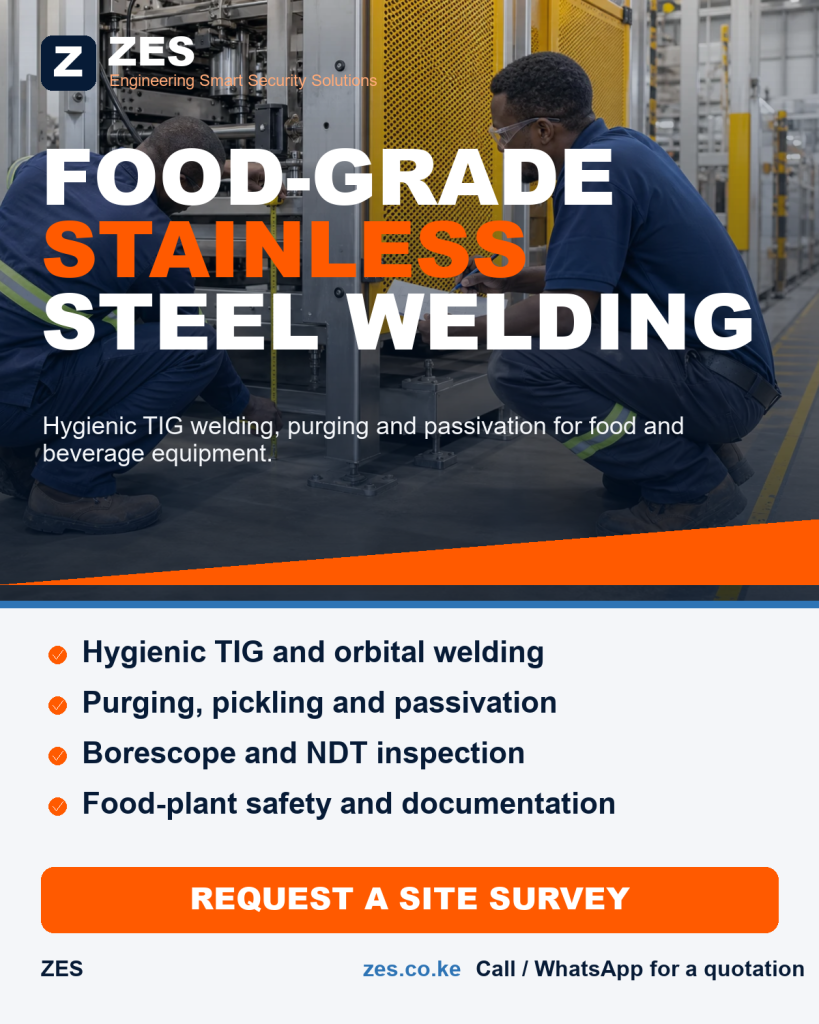
In food and beverage production, a weld is not just a joint. It is a surface that will contact food, be washed with chemicals, and be inspected by auditors. A weld that is strong but rough, discoloured or full of crevices can harbour bacteria, corrode and fail a hygiene audit — even if the equipment looks fine from the outside.
Define the hygienic welding requirement
For a ZES quotation, share product-contact duty, specified material grade, cleaning regime, joint details, surface-finish requirements and the inspection or audit criteria. The team can then confirm the assessment, fabrication, site work and supporting specialists required for your project.
Ask the written proposal to identify materials, quantities, preparation, finishing, installation, inspection, exclusions and handover records. Any required welder qualifications, specialist tests or compliance documents must be confirmed for the actual scope before appointment.
Food-grade stainless steel welding in Kenya is the specialist practice of welding stainless steel so that it is hygienic, corrosion-resistant and cleanable. It requires the right grade, the right process, careful heat control, proper shielding and purging, and correct finishing and passivation.
This guide explains what food-grade welding involves, the grades and processes used, how hygienic welds are designed and made, how to finish and passivate them, how to inspect them, the common defects, and how to choose a contractor who can deliver welds that pass audit and last.
It is written for food factory engineers, quality and food safety managers, maintenance teams, fabricators, and business owners in the food and beverage sector.
What Food-Grade Stainless Steel Welding Is
Food-grade welding is welding performed to a standard suitable for food contact and food environments.
It includes:
Food-contact surfaces. Tables, conveyor parts, chutes, tanks and utensils.
Splash and washdown zones. Surfaces exposed to food residues and cleaning.
Hygienic pipework. Product lines and clean-in-place circuits.
Equipment frames. Supports and structures in food areas.
Tanks and vessels. Storage, mixing and processing vessels.
Repairs. Restoring hygienic surfaces after damage or wear.
It is defined less by the material alone and more by the combination of material, design, welding and finishing.
Why Food-Grade Welding Matters
Food-grade welding protects consumers, brands and equipment.
Hygiene. Smooth, cleanable welds reduce bacterial harbourage.
Corrosion resistance. Proper welding and passivation maintain the protective oxide layer.
Food safety. Contamination from corrosion or crevices can cause illness and recalls.
Audit compliance. Food safety audits examine welds, surfaces and documentation.
Equipment life. Poor welds corrode and fail prematurely.
Product quality. Rough surfaces and corrosion can affect taste and shelf life.
Brand reputation. A recall or hygiene failure damages trust.
The cost of poor welding is measured in far more than repair bills.
Grades Used in Food-Grade Welding
Material selection is the foundation.
Grade 304
Grade 304 is the standard food-grade stainless steel. It offers good corrosion resistance, formability and weldability. It suits most food-contact surfaces, tables, tanks and equipment.
Grade 304L
The low-carbon version reduces the risk of carbide precipitation during welding, which improves corrosion resistance in the heat-affected zone. It is often preferred for welded food equipment.
Grade 316 and 316L
Grade 316 contains molybdenum for improved resistance to chlorides and aggressive environments. The low-carbon version, 316L, is common in welded food and dairy equipment. It is used in dairy, meat, seafood, brine and chemical-cleaning environments.
Duplex Stainless Steels
Duplex grades offer higher strength and corrosion resistance for demanding applications.
Filler Metals
Filler metals must match the base material and application. Using the wrong filler can cause corrosion, cracking or loss of hygiene.
A contractor should specify the grade and filler, and explain why.
Welding Processes for Food-Grade Work
Process selection affects quality and hygiene.
TIG Welding
Tungsten inert gas welding offers precise control, clean welds and good appearance. It is the most common process for hygienic stainless welding, especially on thin sections and food-contact surfaces.
Orbital Welding
Automated orbital welding is used for hygienic pipework, providing consistent, repeatable welds with controlled parameters.
MIG Welding
MIG can be used for thicker sections and frames, but requires care to avoid spatter and rough finish on food-contact areas.
Plasma Welding
Plasma welding offers precise, high-quality welds for specific applications.
Stick Welding
Stick welding is generally unsuitable for thin stainless and hygienic finishes, though it may be used for structural mild steel elements.
The process should suit the material, thickness, position and hygiene requirement.
Joint Design for Hygiene
Hygienic welding begins with hygienic joint design.
Full-penetration welds. Weld through the joint to avoid gaps.
Butt welds. Preferred for hygienic applications because they can be finished flush.
Avoid lap joints. Lap joints create crevices and are generally avoided in food-contact areas.
Smooth transitions. Radiused transitions reduce dirt traps.
Drainable joints. Avoid areas where liquid can pool.
Access for finishing. The welder must be able to finish the weld properly.
Access for inspection. Internal welds may need borescope access.
Removable joints. Where cleaning requires dismantling, design for it.
Good joint design is cheaper than cleaning a poor weld for years.
Heat Control and Distortion
Stainless steel is sensitive to heat.
Low heat input. Reduces distortion and carbide precipitation.
Interpass temperature. Controlled to avoid overheating.
Welding sequence. Balanced sequencing reduces distortion.
Clamping and jigging. Holds components in place during welding.
Backing and purging. Supports the weld and prevents oxidation.
Thin material. Requires particular care to avoid burn-through.
Post-weld straightening. Sometimes needed, but avoid excessive heat.
Distortion and heat damage are common causes of rework.
Shielding and Purging
Shielding and purging protect the weld.
Shielding gas. Protects the molten weld from atmosphere.
Gas flow. Correct flow rate and coverage.
Wind. Disrupts shielding; use screens or appropriate processes.
Purging. For pipework and tanks, internal purging with inert gas prevents oxidation on the backside of welds.
Oxygen measurement. Purge quality can be measured.
Purge dams. Keep purge gas in the weld area.
Safety. Inert gas displaces oxygen; confined space precautions apply.
Oxidised internal welds (heat tint) reduce corrosion resistance and cleanliness.
Finishing: Grinding, Pickling and Passivation
Finishing determines hygiene and corrosion resistance.
Grinding. Removes weld reinforcement and smooths joints.
Polishing. Provides the required surface finish.
Heat tint removal. Discolouration must be removed; it can become a corrosion site.
Pickling. Removes scale, heat tint and contamination using acid-based products.
Passivation. Restores the passive oxide layer that protects stainless.
Rinsing. Removes chemical residues.
Verification. Tests can confirm passivation.
Safety. Chemicals require proper handling and disposal.
Skipping finishing or passivation can lead to rapid corrosion at welds.
Inspection of Food-Grade Welds
Inspection confirms hygiene and integrity.
Visual inspection. Weld appearance, finish and cleanliness.
Dye penetrant testing. Surface-breaking defects.
Radiographic or ultrasonic testing. Internal defects where required.
Borescope inspection. Internal welds in tanks and pipework.
Passivation testing. Confirms the passive layer.
Surface roughness testing. Confirms cleanability where specified.
Dimensional checks. Fit and alignment.
Documentation. Records of inspection and results.
Inspection should be planned before fabrication begins.
Common Defects in Food-Grade Welding
Defects affect hygiene and corrosion.
Heat tint. Oxidation that reduces corrosion resistance.
Lack of fusion. Insufficient bonding.
Porosity. Gas trapped in the weld.
Undercut. Groove along the weld edge.
Cracks. From heat, restraint or contamination.
Distortion. Warping from excessive heat.
Rough finish. Surfaces that trap dirt.
Crevices. Gaps that harbour bacteria.
Spatter. Metal droplets on surfaces.
Incomplete penetration. Gaps inside the joint.
Understanding defects helps buyers and inspectors.
Standards and Hygienic Design
Food-grade welding operates within standards and guidelines.
Hygienic design principles. Smooth, cleanable, drainable surfaces without crevices.
Food safety management. HACCP-based systems require control of contamination risks.
Material standards. Food-contact materials must be suitable.
Welding standards. Procedures and qualification.
Surface finish standards. Roughness may be specified for certain products.
Inspection standards. NDT methods and acceptance criteria.
Audit requirements. Customers and regulators may audit welding and documentation.
A contractor familiar with hygienic design produces equipment that is easier to approve.
Working in Food Plants
Welding in food plants requires discipline.
Permits. Hot work permits and isolation.
Screens and protection. Protect product, equipment and surfaces.
Fume and dust control. Extract fumes and control grinding dust.
Fire safety. Clear combustibles, fire watch and extinguishers.
Hygiene. Clean and inspect before production resumes.
Access control. Restrict access to the work area.
Coordination. Work with production and quality teams.
Documentation. Record work, materials and sign-off.
Working in a food plant is a food safety responsibility, not just a welding job.
What Affects Food-Grade Welding Cost
Cost depends on specification and conditions.
Material. 316L and thicker sections cost more.
Joint design. Full penetration and hygienic joints take longer.
Welding process. TIG is slower than MIG.
Purging. Adds time and gas.
Finishing. Pickling and passivation add cost.
Inspection. NDT and documentation add cost.
Access. Confined spaces and difficult locations increase labour.
Downtime constraints. Working in a live plant adds complexity.
A good quotation itemises material, welding, finishing, inspection and documentation.
How to Choose a Food-Grade Welding Contractor
Use this checklist.
1. Do they understand hygienic design? Joints, crevices and cleanability.
2. Do they specify grade and filler? 304L, 316L and matching consumables.
3. Do they control heat and use purging? For clean internal welds.
4. Do they pickle and passivate? Essential for corrosion resistance.
5. Do they inspect? Visual, NDT and borescope.
6. Do they provide documentation? Procedures, certificates and reports.
7. Can they work in food plants? Permits, protection and hygiene.
8. Do they have relevant experience? Dairy, meat, beverage or food.
9. Do they show comparable work? References and examples.
10. Are they safe? Chemicals, hot work and confined spaces.
Common Mistakes in Food-Grade Welding
Wrong grade or filler. Corrosion or cracking.
Lap joints in food-contact areas. Crevices and dirt traps.
No purging. Oxidised internal welds.
Excess heat. Distortion and reduced corrosion resistance.
No heat tint removal. Corrosion at welds.
No passivation. Loss of the protective oxide layer.
Rough welds. Surfaces that cannot be cleaned.
No inspection. Defects go unnoticed.
Poor protection during work. Contamination of product and equipment.
Choosing only on price. Cheap work fails audits and costs more.
Food-Grade Welding by Sector
Dairy: tanks, pipework, hygienic welds and passivation.
Meat and poultry: tables, conveyors and wash stations.
Beverages: tanks, pipework and hygienic fabrication.
Bakery: frames, conveyors and equipment.
Fruit and vegetables: wash stations, conveyors and tables.
Confectionery: tables, frames and equipment.
Pharmaceuticals: hygienic equipment and cleanroom fabrication.
Food service: kitchen equipment and stainless fabrication.
Each sector has specific requirements, and a good contractor adapts.
Welder Qualification for Food-Grade Work
Food-grade welding demands skilled, qualified welders.
Stainless experience. Thin sections, heat control and distortion.
TIG skill. Precise, clean welds on food-contact surfaces.
Purging experience. Internal welds in pipework and tanks.
Finishing skills. Grinding, polishing and passivation.
Hygiene awareness. Understanding cleanability and contamination.
Documentation habits. Recording procedures and results.
Qualification records. Evidence of competence.
Continuous training. Keeping skills current.
The welder's skill is the most important variable in weld quality.
Sanitary Pipework Welding
Hygienic pipework is critical in food and beverage plants.
Orbital welding. Automated, consistent welds for repeatable quality.
Manual TIG. Used where orbital is not practical.
Purging. Essential for clean internal welds.
Fit-up. Accurate alignment and gap control.
Inspection. Borescope inspection of internal welds.
Documentation. Weld logs and parameters.
Clean-in-place compatibility. Welds must support cleaning.
Drainability. Pipework should drain fully.
Poor pipework welds create cleaning and contamination problems.
Hygienic Design of Tanks and Vessels
Tanks require hygienic design and welding.
Internal surfaces. Smooth, cleanable and fully welded.
Corners. Radiused to reduce dirt traps.
Drainage. Outlets and slopes for complete drainage.
Covers and vents. Prevent contamination while allowing access.
Nozzles and fittings. Careful welding to avoid crevices.
Supports. Allow cleaning underneath.
Inspection access. Borescope and access openings.
Testing. Leak and pressure testing.
Hygienic tanks are designed, not just welded.
Surface Finish and Cleanability
Surface finish affects hygiene.
Roughness. Rough surfaces harbour bacteria and are hard to clean.
Specifications. Some products require specific surface finishes.
Mechanical finishing. Grinding and polishing.
Chemical finishing. Pickling and passivation.
Measurement. Surface roughness can be tested.
Consistency. Finish should be consistent across surfaces.
Inspection. Visual and tactile checks.
Maintenance. Finishes degrade with wear and cleaning.
Cleanability is a design outcome, not an accident.
Welding Documentation and Traceability
Documentation supports audits and quality.
Welding procedures. Specification of the process.
Welder qualification. Evidence of competence.
Material certificates. Grade and traceability.
Consumable records. Filler and gas.
Inspection reports. Visual and NDT results.
Passivation records. Treatment and verification.
Drawings. As-built records.
Repair records. What was done and why.
Traceability supports food safety and customer confidence.
Maintenance of Food-Grade Welds
Welds need care over time.
Inspection. Regular checks for corrosion, cracks and damage.
Cleaning. Suitable products and methods.
Passivation. Re-passivation after damage or welding.
Repair. Address defects promptly.
Documentation. Record maintenance.
Training. Staff should recognise problems.
Review. Use records to plan repairs.
Maintenance preserves hygiene and corrosion resistance.
Common Food-Grade Welding Problems and Fixes
Most problems have known causes and remedies.
Heat tint. Cause: oxidation. Fix: improved shielding, pickling and passivation.
Porosity. Cause: contamination or gas issues. Fix: cleaning, gas flow and consumable control.
Lack of fusion. Cause: insufficient heat or poor technique. Fix: procedure and welder qualification.
Crevices. Cause: joint design. Fix: redesign to full-penetration butt joints.
Rough surfaces. Cause: poor finishing. Fix: grinding, polishing and inspection.
Corrosion at welds. Cause: wrong grade, heat tint or no passivation. Fix: correct material and finishing.
Distortion. Cause: excess heat. Fix: heat control, sequencing and clamping.
Leaks. Cause: incomplete penetration or defects. Fix: testing and repair.
Understanding causes prevents repeat problems.
Choosing Between TIG and Orbital Welding
Both processes have strengths.
TIG is flexible, suitable for complex geometry and small runs, and gives excellent control. It depends heavily on welder skill.
Orbital is automated, consistent and repeatable, ideal for pipework and repetitive joints. It requires equipment and programming.
Quality. Both can achieve hygienic quality with proper procedure and inspection.
Productivity. Orbital is faster for repetitive pipe welds.
Cost. Orbital equipment is expensive; TIG is more accessible.
Access. TIG suits confined or irregular locations; orbital needs suitable geometry.
Inspection. Both require inspection; orbital records parameters automatically.
The right choice depends on the work and the volume.
Hygienic Welding for Conveyors and Tables
Common food equipment needs hygienic welds.
Conveyor frames. Smooth welds and no crevices where product contacts.
Tables. Flush joints and radiused edges.
Chutes. Smooth internal surfaces for product flow and cleaning.
Guards. Cleanable and securely fixed.
Supports. Designed for cleaning underneath.
Fasteners. Minimised and cleanable.
Finishing. Grinding and passivation.
Inspection. Visual and hygiene checks.
Even simple equipment benefits from hygienic welding discipline.
Audit Preparation for Welded Equipment
Food safety audits examine welded equipment.
Documentation. Procedures, certificates and inspection records.
Weld appearance. Smooth, clean and free of defects.
Cleanability. Access for cleaning and no crevices.
Corrosion. No rust or heat tint.
Maintenance records. Evidence of care.
Corrective actions. How issues were resolved.
Traceability. Materials and work records.
Training. Staff awareness.
Preparation reduces audit findings and builds confidence.
Building a Food-Grade Welding Programme
Producers can plan welding quality.
Standards. Define hygienic welding requirements.
Approved contractors. Pre-qualify welders and fabricators.
Specifications. Grade, joint design, finishing and inspection.
Inspection. Routine checks of new and repaired equipment.
Documentation. Records for audits.
Maintenance. Scheduled inspection and repair.
Training. Staff awareness of weld hygiene.
Review. Improve based on findings.
A programme turns welding quality into a managed system.
Frequently Asked Questions
What is food-grade stainless steel welding?
It is welding performed to a hygienic standard for food-contact and food-environment surfaces, using suitable grades, processes, finishing and passivation.
Which grade is used for food-grade welding?
Grade 304 or 304L is common, while 316 or 316L is used where higher corrosion resistance is required. The grade should match the product and cleaning environment.
What is purging in stainless welding?
Purging is the use of inert gas on the backside of a weld to prevent oxidation, producing clean internal welds in pipework and tanks.
What is passivation?
Passivation restores the protective oxide layer on stainless steel after welding or damage, improving corrosion resistance.
Why is heat tint a problem?
Heat tint is oxidation that reduces corrosion resistance and can become a corrosion site. It should be removed by pickling or mechanical means.
Do you pickle and passivate welds?
Yes, where required. Pickling and passivation are part of hygienic finishing.
How are food-grade welds inspected?
Through visual inspection and, where required, dye penetrant, radiographic, ultrasonic or borescope inspection, plus passivation testing.
Can you weld in a food plant?
Yes, with permits, isolation, protection, cleaning and coordination with production and quality teams.
Do you provide documentation?
Yes. Procedures, material certificates, inspection reports and passivation records can be provided.
Do you work outside Nairobi?
Yes. Services can be provided across Kenya, with logistics reflected in the quotation.
A Final Pre-Purchase Checklist
Before engaging a food-grade welding contractor, confirm the following. Make sure they specify grade and filler. Check their joint design for hygienic requirements. Confirm purging, heat control and finishing. Ask about pickling and passivation. Confirm inspection and documentation. Ask about working safely in food plants. Request references in similar food processes. Confirm the programme and access. Finally, compare quotations against the same hygiene specification.
A contractor who explains these points clearly is usually the one worth trusting with food-grade work.
Conclusion
Food-grade stainless steel welding in Kenya is a hygiene and engineering discipline. The difference between a weld that passes audit and lasts, and one that corrodes or harbours bacteria, is the grade, the joint design, the process, the purging, the finishing, the passivation and the inspection.
If you need food-grade welding, start with the product, the cleaning regime and the hygiene standard. Then insist on correct materials, hygienic joints, controlled welding and documented finishing.
ZES provides food-grade stainless steel welding, fabrication, passivation and inspection for food and beverage producers across Kenya. If you would like a practical assessment and a clear, itemised quotation, start with a site visit.
Request a food-grade welding assessment and quotation from ZES
Related Welding Services
Explore the rest of our welding and fabrication capability: