
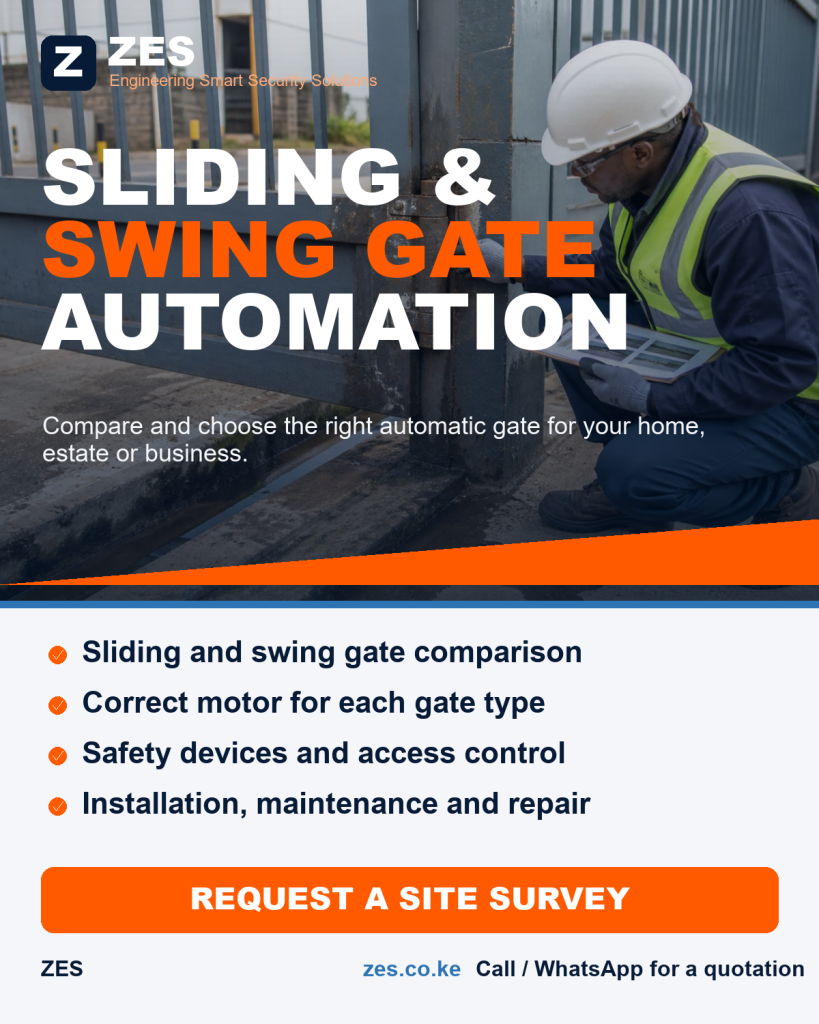
Two gate types dominate automatic entrances in Kenya: sliding gates and swing gates. Both can be automated, both can be secure and both can look excellent. But they behave differently, need different space, suit different sites and require different motors and safety planning.
Choosing the wrong type leads to gates that cannot open fully, motors that strain, safety problems and costly modifications. Choosing the right one gives years of smooth, safe operation.
This comparison guide explains sliding and swing gate automation in Kenya, the differences that matter, how to choose for homes, estates and businesses, the motors and safety systems involved, installation and maintenance considerations, and what affects cost.
It is written for homeowners, estate managers, developers, business owners and facility managers.
The Core Difference
The essential difference is how the gate moves.
Sliding gates move sideways along a track or cantilever structure. They need a clear run area beside the entrance.
Swing gates rotate on hinges and swing inward or outward. They need clearance for the leaves to swing.
Everything else — cost, safety, motors, installation — follows from that difference.
Sliding Gate Automation Explained
A sliding gate is supported by rollers on a track or by a cantilever structure, and driven by a rack-and-pinion motor.
How it works. The motor turns a pinion gear that engages a rack fixed to the gate, moving it sideways.
Space. The gate needs a run area equal to its width, plus clearance at the end.
Support. Track systems need a level, clear track. Cantilever systems avoid a track but need a strong structure.
Motors. Rated for gate weight, length and frequency of use.
Safety. Obstruction detection, safety edges and photocells prevent the gate trapping people or vehicles.
Advantages. Less clearance than swing gates at the entrance, good for wide driveways, reliable automation.
Limitations. Needs a run area, and track systems need maintenance.
Sliding gates are popular in Kenya because they suit many entrances and automate reliably.
Swing Gate Automation Explained
A swing gate rotates on hinges and is driven by an arm, piston or underground operator.
How it works. The motor pushes or pulls the gate leaf to rotate it open or closed.
Space. The gate needs clearance for the leaves to swing, both inside and outside the property depending on the opening direction.
Support. Strong hinges and posts carry the gate's weight.
Motors. Articulated arm, piston or underground operators, rated for gate weight and width.
Safety. Crush zones, safety edges and photocells protect people in the swing path.
Advantages. Traditional appearance, no ground track, good for narrower driveways with adequate clearance.
Limitations. Needs swing clearance, and larger leaves place more load on hinges and motors.
Swing gates suit homes and entrances where clearance is available.
Sliding vs Swing: A Practical Comparison
| Consideration | Sliding gate | Swing gate |
|—|—|—|
| Space needed | Run area beside the gate | Clearance for leaves to swing |
| Wide driveways | Excellent | Possible with double leaves |
| Narrow driveways | Good if a run area exists | Good if clearance exists |
| Ground track | Often required (unless cantilever) | None |
| Automation | Rack-and-pinion, reliable | Arm, piston or underground |
| Hinge/pivot wear | Rollers and track wear | Hinges and posts wear |
| Safety risks | Crushing at the closing edge | Crushing and shear in the swing path |
| Maintenance | Track cleaning, rollers, rack | Hinges, arms, alignment |
| Typical use | Homes, estates, commercial, industrial | Homes, traditional entrances |
| Appearance | Modern, practical | Traditional, architectural |
The comparison is not about which is better in general, but which suits the site.
How to Choose for Homes
For a home, the driveway usually decides.
Choose sliding if: the driveway is wide, there is a run area beside the entrance, or you want reliable automation with less swing clearance.
Choose swing if: the entrance is traditional, there is clearance for the leaves, and the gate design suits swinging.
Consider pedestrians. A separate pedestrian gate improves safety and convenience.
Consider children and pets. Safety devices are essential for both types.
Consider power. Backup or solar may be needed.
Consider maintenance. Sliding gates need track care; swing gates need hinge care.
A home gate should balance security, appearance and daily convenience.
How to Choose for Estates and Businesses
Commercial and shared entrances have different priorities.
Traffic. High traffic favours durable motors and, often, sliding or barrier gates.
Space. Estates with wide entrances often use sliding gates for reliability.
Access control. Both types can integrate with tags, intercoms and CCTV.
Safety. Pedestrian separation is important in shared spaces.
Reliability. Commercial gates need duty-rated motors and planned maintenance.
Emergency access. Manual release and emergency override are essential.
Maintenance. Shared gates need a maintenance arrangement and budget.
For high-traffic sites, the gate type should support throughput and durability.
Motors for Each Gate Type
Motor selection differs.
Sliding gates. Rack-and-pinion motors, rated for gate weight and length. Cantilever gates may use different drive arrangements.
Swing gates. Articulated arm, piston or underground operators, rated for leaf weight and width.
Duty cycle. Higher for commercial and estate gates.
Power. Mains, battery backup or solar.
Safety inputs. For photocells and safety edges.
Manual release. Essential for both.
Support. Choose motors with local spares and service.
The motor must be matched to the gate, not chosen separately.
Safety for Sliding and Swing Gates
Both types need safety systems, but the risks differ.
Sliding gate risks. Crushing at the closing edge, trapping between the gate and the post, and impact with vehicles.
Swing gate risks. Crushing and shear in the swing path, trapping between the leaf and the post or wall.
Common safety devices. Obstruction detection, safety edges, photocells, warning lights, force limits, emergency release and signage.
Pedestrian separation. Keep foot traffic away from vehicle gates.
Testing. Safety devices must be tested at commissioning and during maintenance.
Supervision. Children should not play near automated gates.
Safety is not optional for either type.
Installation Differences
Installation reflects the gate type.
Sliding gate installation. Foundations, track or cantilever structure, motor mounting, rack fitting, alignment and safety devices.
Swing gate installation. Strong posts and hinges, motor mounting, arm or piston fitting, alignment and safety devices.
Commissioning. Limits, force, speed and safety settings for both.
Training. Operators must know how to use the manual release.
Documentation. Manuals and warranty information.
Poor installation causes most gate problems, regardless of type.
Maintenance Differences
Maintenance needs differ.
Sliding gates. Track cleaning, roller checks, rack and pinion lubrication, motor checks and safety testing.
Swing gates. Hinge lubrication, arm and piston checks, alignment, motor checks and safety testing.
Both. Battery checks, controller checks, access control checks and safety testing.
Frequency. Based on usage: annual for homes, more often for commercial gates.
Records. Track maintenance and repairs.
Regular maintenance extends life and protects safety.
What Affects Cost
Cost depends on the gate and the site.
Gate size and weight. Larger and heavier gates cost more.
Gate type. Sliding and swing gates differ in fabrication and motor cost.
Motor type. Rack-and-pinion, arm, piston and underground operators vary.
Ground works. Tracks, foundations and clearance work add cost.
Safety devices. Photocells and safety edges add cost.
Access control. Remotes, intercoms and tags add cost.
Power. Backup and solar systems add cost.
Installation. Site access and conditions affect labour.
Maintenance. Ongoing servicing should be budgeted.
A good quotation itemises equipment, labour, wiring and commissioning.
How to Choose a Contractor
Use this checklist.
1. Do they survey the site? Space, ground and power.
2. Do they recommend the right gate type? Based on the site, not preference.
3. Do they specify the motor rating? Matched to weight and usage.
4. Do they explain safety devices? For the specific gate type.
5. Do they provide an itemised quotation? Transparent pricing.
6. Do they handle installation and commissioning? Complete service.
7. Do they offer access control? Remotes, intercoms and tags.
8. Do they offer maintenance? Ongoing support.
9. Do they have references? Both gate types.
10. Do they provide documentation? Manuals and warranty.
Common Mistakes
Choosing a gate that does not fit the space. Clearance or run area problems.
Undersized motors. Early failure.
No safety devices. Serious risk.
Poor installation. Binding, misalignment and strain.
No manual release. Locked out during outages.
No maintenance. Gradual failure.
Ignoring access control. Security gaps.
Choosing only on price. Cheap systems cost more over time.
Gate Automation Costs Compared
The headline price is rarely the whole story.
Sliding gate costs. The gate, track or cantilever structure, motor, rack, controls and installation. Cantilever systems cost more than track systems but avoid track maintenance.
Swing gate costs. The gate, hinges and posts, motor (arm, piston or underground), controls and installation. Underground motors cost more but hide the mechanism.
Common costs. Safety devices, access control, power and backup, and commissioning apply to both.
Ground works. Sliding gates often need a track and drainage; swing gates often need stronger posts and foundations.
Maintenance. Sliding gates need track care; swing gates need hinge care.
Whole-life cost. Consider motor life, maintenance and replacement.
Comparing quotations should include these elements, not just the gate price.
Choosing Based on Driveway Layout
The driveway usually decides the gate type.
Wide driveway with a run area. Sliding gates are an excellent fit.
Wide driveway without a run area. Double swing gates or bi-fold gates may work.
Narrow driveway. Single swing gates or telescopic sliding gates may suit.
Sloped driveway. Cantilever sliding gates or carefully specified swing gates.
Corner entrance. Swing gates may be easier where a run area is unavailable.
Tight urban plot. Bi-fold or telescopic gates reduce space requirements.
Long entrance. Sliding gates can be designed for long runs.
A site sketch and survey clarify the best option.
Upgrading an Existing Gate to Automation
Many properties already have a gate.
Assess the gate. Condition, weight, material and rigidity.
Check the support. Hinges, posts, track or cantilever.
Check clearance. Swing clearance or run area.
Reinforce if needed. Automation adds force and needs a strong gate.
Select the motor. Matched to the gate type and weight.
Add safety devices. Essential for any automated gate.
Plan power. Mains, battery backup or solar.
Commission and test. Limits, force and safety.
Upgrading can be cost-effective if the gate is sound; otherwise replacement is better.
Security Comparison
Both gate types can be secure, but the risks differ.
Sliding gates. Strong barrier when closed; the run area can create a climbing opportunity if not designed well.
Swing gates. Strong barrier when closed; the swing path can create gaps during operation.
Anti-lift devices. Prevent the gate being lifted off its track.
Spear tops and panels. Deter climbing and improve privacy.
Locking. Motors and mechanical locks secure the gate.
Integration. Both can integrate with CCTV, alarms and access control.
Lighting. Improves visibility and deters intrusion.
Monitoring. Sensors and alarms detect forced entry.
Security depends more on the gate design, integration and management than on the type alone.
Which Gate Suits Which Property
A practical summary.
Homes with wide driveways and a run area. Sliding gates.
Homes with clearance and a traditional entrance. Swing gates.
Estates with high traffic. Heavy-duty sliding gates or barriers.
Businesses with delivery traffic. Sliding gates or barriers with access control.
Tight urban plots. Bi-fold or telescopic gates.
Sloped or uneven ground. Cantilever sliding gates.
Institutions needing pedestrian separation. Sliding vehicle gate with a separate pedestrian gate.
Industrial sites. Heavy-duty sliding gates or barriers.
The right choice emerges from the site survey.
Frequently Asked Questions
Which is better, a sliding or swing gate?
Neither is universally better. Sliding gates need a run area; swing gates need swing clearance. The right choice depends on the site, traffic and style.
Which gate is cheaper to automate?
It depends on the gate and site. Both can be automated, but ground works and motor type affect cost. Request quotations for both options.
Can both gate types be automated?
Yes. Sliding gates use rack-and-pinion motors; swing gates use arm, piston or underground operators.
Which gate is safer?
Both can be safe with proper safety devices and installation. The risks differ: sliding gates have a closing edge; swing gates have a swing path.
Which gate needs less space?
Sliding gates need a run area beside the entrance; swing gates need clearance to swing. The comparison depends on the site layout.
Which gate is better for high traffic?
Duty-rated motors and durable structures matter more than gate type. Both can handle high traffic when specified correctly.
Can both integrate with access control?
Yes. Remotes, keypads, intercoms, tags and biometrics can work with both.
How often should automatic gates be serviced?
At least annually, and more often for high-traffic commercial gates.
Can I automate an existing gate?
Often yes, if the gate is in good condition and suitable for automation.
Do you work outside Nairobi?
Yes. Installation and support can be arranged across Kenya.
Conclusion
Sliding and swing gate automation in Kenya both deliver secure, convenient entrances, but they suit different sites. The right choice depends on space, clearance, traffic, power and appearance.
If you are deciding between them, start with the entrance and the site survey. Then choose the gate and motor together, plan safety and access control, and arrange maintenance.
ZES designs, installs and maintains sliding and swing gate automation for homes, estates and businesses across Kenya. If you would like a practical assessment and a clear, itemised quotation, start with a site survey.
Request a gate automation survey and quotation from ZES
Related Gate Automation Services
Explore our full gate and access-control capability:
- Electric gate motor installation and repair
- Automatic gate installation
- Sliding gate motors
- Automatic swing gates
- Gate access control systems
- Automatic driveway gates
- Commercial automatic gate systems
- Solar powered automatic gates
- Automatic gate maintenance
- Automatic gate repair
- Gate welding and fabrication services