
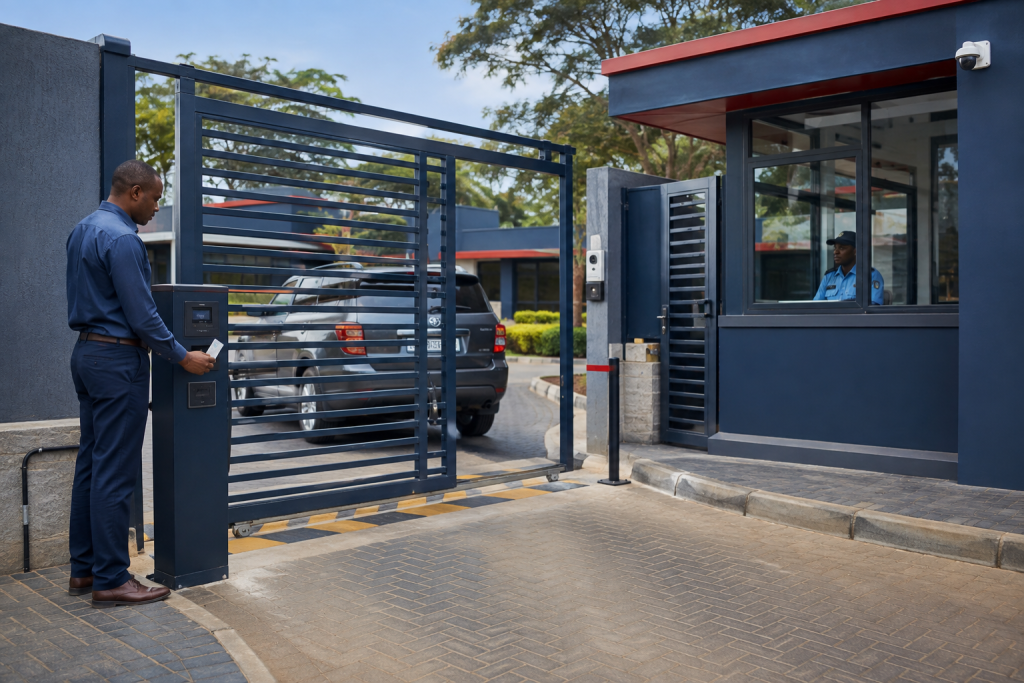
An access control gate system decides who may enter, while the gate automation equipment moves the gate. Treating those as separate design layers helps Kenyan homes, apartments and businesses avoid a common mistake: a gate that opens remotely but has no clear user, visitor or emergency process.
What the integrated system can contain
A vehicle entrance may combine a gate motor, controller interface, credential reader, intercom, guard station, safety sensors and optional CCTV or vehicle-management tools. A pedestrian gate may use its own lock and reader. Each component should have a defined role and confirmed compatibility.
Define authorization before choosing credentials
Start with people and rules. Identify residents or staff, visitors, contractors, deliveries, security personnel and administrators. Decide who approves each category, how long access remains valid and what happens when a remote, card or phone is lost.
Common credential and control options
- Coded remotes: convenient for known vehicle users, with a process needed for issue and deletion.
- Cards or tags: manageable for staff or residents when the controller supports individual records.
- Keypads: useful for controlled codes, but shared codes require disciplined change procedures.
- Mobile credentials: may support remote administration but depend on compatible platforms and connectivity.
- Intercom approval: lets an authorized person verify visitors before releasing the gate.
- Guard control: supports staffed sites but needs clear procedures and override accountability.
Vehicle recognition and biometric options
Number-plate recognition or biometric verification may be considered where the operational need, environment, privacy duties and integration capability justify it. These technologies are not universally suitable and should not be presented as infallible. A fallback process is needed for unreadable plates, device faults and authorized exceptions.
Visitor management at the gate
A good visitor flow answers four questions: who is requesting entry, who can approve it, how long approval lasts, and how exit is handled. Apartments may route calls to residents; offices may use reception or security; industrial sites may check deliveries against a schedule. The gate should not remain open simply because approval takes too long.
Access records and privacy
If the controller records names, credentials, images, plates or timestamps, the organization should define a legitimate purpose, limit access to records, set appropriate retention and secure administration. Logging can support operations and incident review, but more data is not automatically better.
Gate safety remains independent
A valid credential tells the system to open; it does not prove the movement path is clear. Obstacle detection, mechanical stops, safe control settings, pedestrian separation and commissioned behavior remain essential. Access logic must not defeat safety devices or unsafe emergency egress.
Plan for outages and system faults
Decide whether the entrance should remain controlled, allow managed opening or use another procedure when power, network or a reader fails. Backup power and manual release need controlled access. Administrators and guards should know how to recognize a fault without bypassing the system indefinitely.
Integration questions to ask
- Which reader and controller interfaces are supported?
- Can individual credentials be added and revoked?
- What functions continue without network connectivity?
- What event data is stored, where and for how long?
- How are visitors and temporary contractors handled?
- Who can use guard or administrator overrides?
- What happens during power failure or controller fault?
- How is the gate’s independent safety layer tested?
Apartment and commercial use cases
For apartments, the priority is often resident credential management plus visitor confirmation; see the automatic apartment gate guide. For commercial buildings, traffic duty, contractors, delivery vehicles and staff lifecycle management are central; see the commercial gate guide.
Frequently asked questions
Can access control open an existing automatic gate?
Often it can through an approved interface, but the gate controller, input type, power arrangement and safety behavior must be checked first.
Can CCTV and intercom be combined with the gate?
They can form part of a coordinated entrance design, subject to compatibility, camera positioning, connectivity and the site’s visitor process.
Does access control guarantee that no unauthorized vehicle enters?
No single device can guarantee that outcome. Credentials, guards, traffic layout, anti-tailgating procedures, monitoring and user discipline all contribute.
Design the access workflow before buying hardware
Read ZES’s broader access control systems and gate automation guidance. Then request a scoped ZES assessment with the site type, user groups, visitor process, traffic and integration requirements.