
Updated 3 November 2026 · Zama Engineering Systems buyer guide
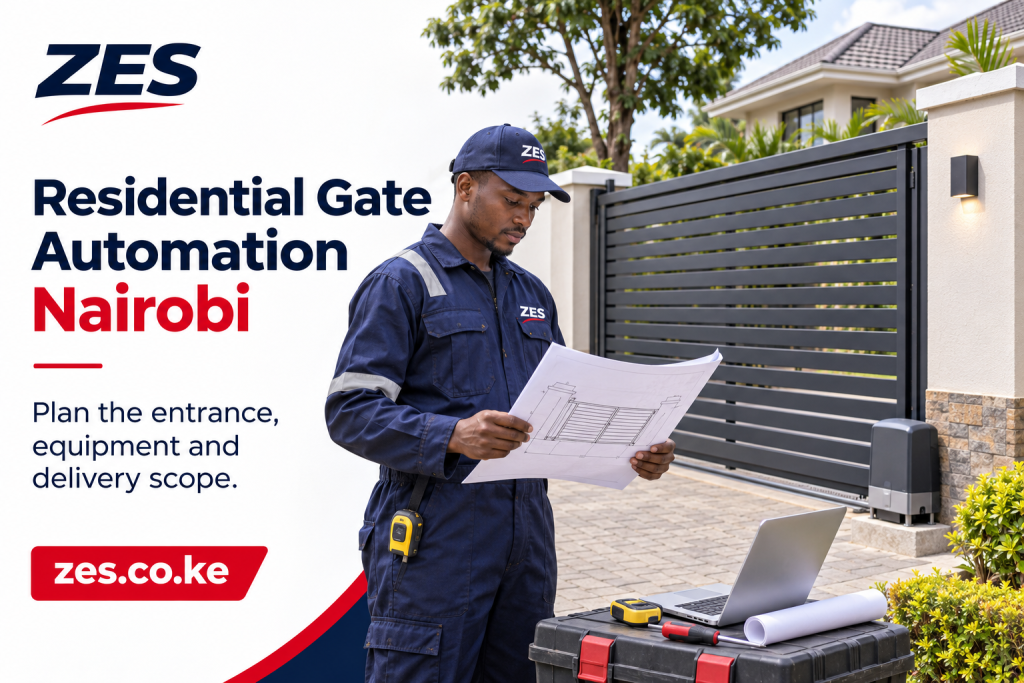
Residential Gate Automation Nairobi should support the people who use the entrance every day, including visitors and household members who may prefer different controls. A motor alone does not establish a practical arrival procedure. This section extends the existing residential gate guide with a user-focused assessment and handover framework for homes and shared residential properties.
Describe everyday arrivals and access needs
Explain who drives, walks, receives deliveries or grants visitor access. Identify whether the property is a single home or a shared development. The competent assessment should consider the actual entrance and users. A control method that works for one technical resident may be inconvenient for others. Keep pedestrian access and the area of gate movement part of the initial discussion rather than an afterthought.
Residential Gate Automation Nairobi: assess the existing gate
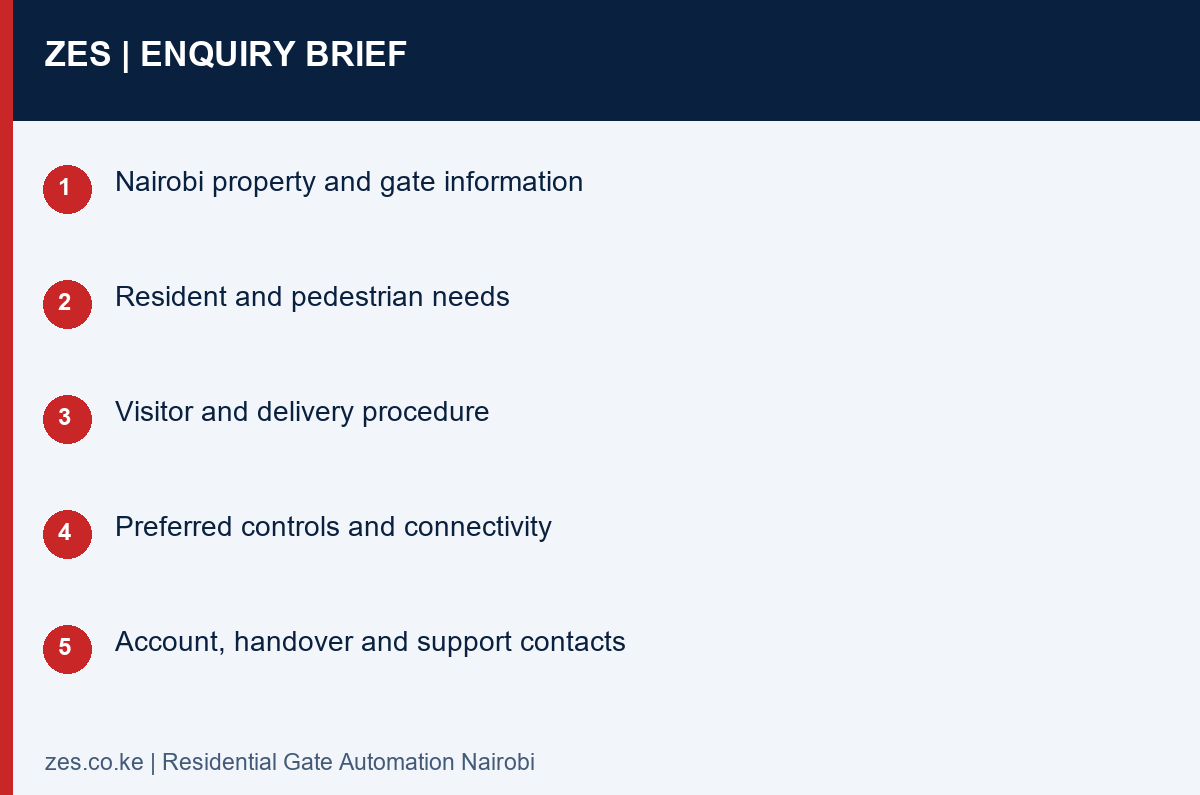
Share the gate type, condition, available records and any planned construction changes. The proposed automation needs review against geometry, duty, supports and relevant safety arrangements. Ask who handles required gate or electrical enabling work. Do not assume that a motor can make an unsuitable physical entrance appropriate. A product image and a preferred control method do not replace an assessment of the actual site.
Choose controls and visitor communication deliberately
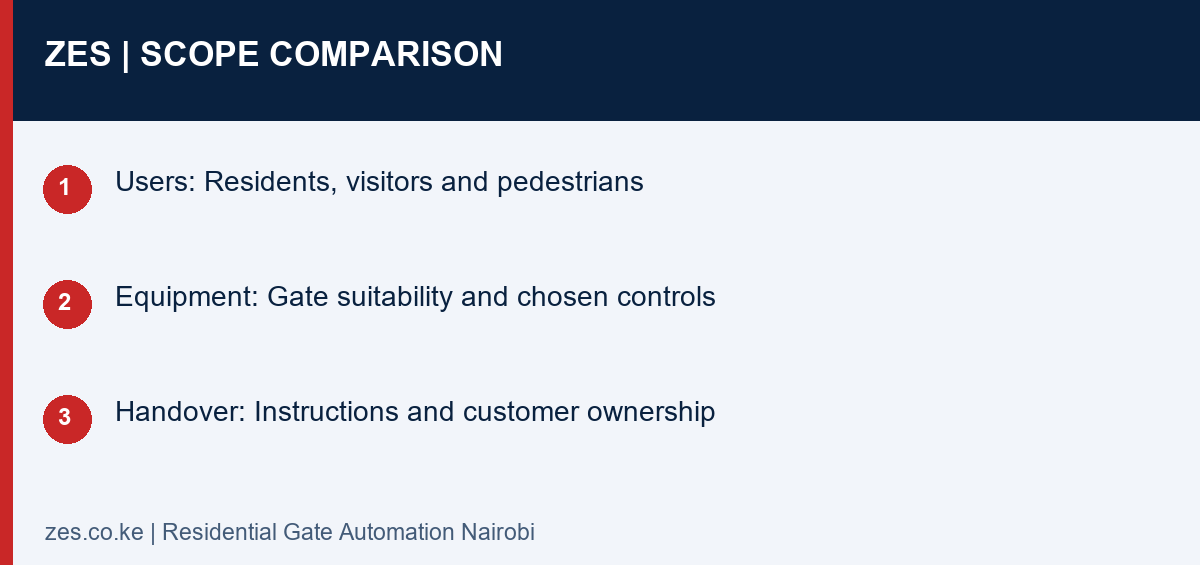
Remotes, keypads and intercoms have different management and connectivity requirements. Agree who authorises visitors, handles lost controls and removes obsolete access. Where apps or accounts are included, establish customer ownership, recurring costs and support access. Confirm which functions work during relevant outages. Features and compatibility should be established for the actual products rather than promised for every available smart-home device.
Demonstrate household use before completion
The responsible parties should complete relevant checks and show the nominated users ordinary operation and appropriate outage information. Provide usable instructions, equipment references and service contacts. Record defects and limitations. Review access when residents, staff or devices change. A good handover makes the entrance understandable to the household instead of leave control with an unexplained installer account or undocumented procedure.
Compare the supplied scope
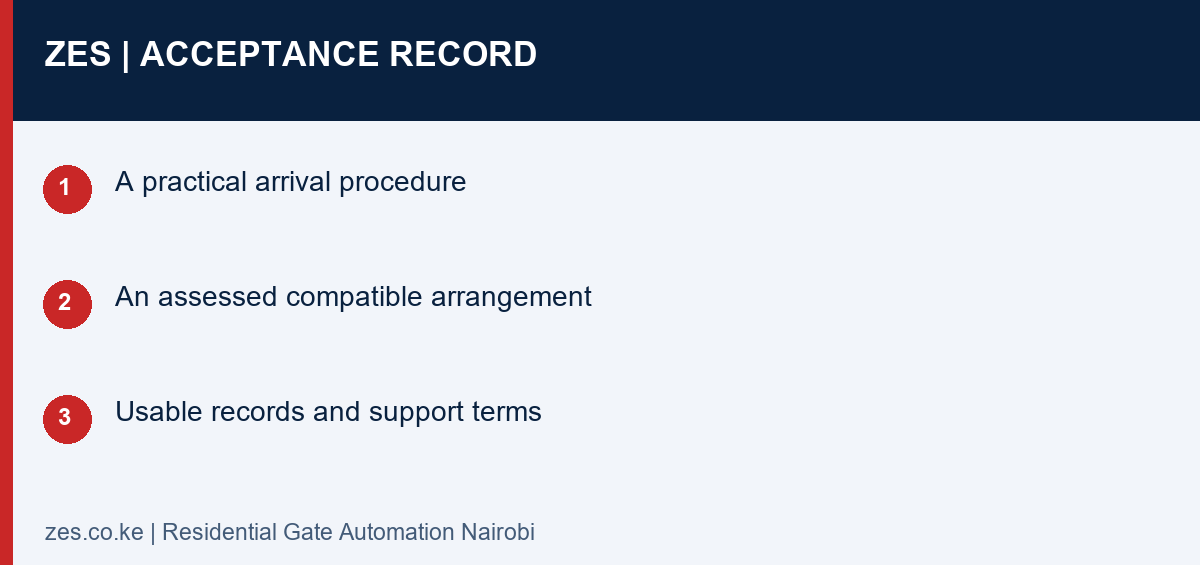
| Decision | Information to confirm | Useful result |
|---|---|---|
| Users | Residents, visitors and pedestrians | A practical arrival procedure |
| Equipment | Gate suitability and chosen controls | An assessed compatible arrangement |
| Handover | Instructions and customer ownership | Usable records and support terms |
A practical planning example
A household may need a simple visitor intercom and controls that several residents can use. Defining those routines can be more useful than selecting the longest feature list. This is an illustrative residential brief, not a completed client claim.
Residential Gate Automation Nairobi: enquiry checklist
- Nairobi property and gate information
- Resident and pedestrian needs
- Visitor and delivery procedure
- Preferred controls and connectivity
- Account, handover and support contacts
Questions before arranging work
Does residential automation guarantee security?
No universal security guarantee is made. Equipment supports an assessed entrance and appropriate operating arrangements.
Can every resident use the same account?
Account and access arrangements should be planned for accountable use and recovery, rather than assume one shared administrator login is suitable.
Discuss the gate requirement with ZES
Read the related ZES gate project guide and explore the service categories. Share the location, equipment information and intended outcome. ZES confirms the appropriate assessment, availability, proposed delivery responsibilities and commercial terms for the actual enquiry.
Request a scoped quotation · Request a site assessment · Call +254 725 345 345
Technical background: HSE powered-gate technical background (UK). This background does not establish Kenyan legal requirements for a particular project. Use the actual product instructions and appropriate project-specific advice.
More detailed project planning
A driveway gate is the daily interface between a property and the outside world. For a home, it protects family and vehicles. For an apartment building, it manages residents, visitors, deliveries and service providers. Automating that gate improves convenience, security and property value — but only if the system is right for the driveway and the people who use it.
This guide explains automatic driveway gates in Kenya, the gate types and motors, how to plan for a home or apartment property, access control for residents and visitors, safety considerations, installation, maintenance, what affects cost, and how to choose a contractor.
It is written for homeowners, apartment owners, estate managers, property managers and developers.
Why Automate a Driveway Gate?
Automatic driveway gates offer practical benefits.
Convenience. Drivers do not leave the car to open the gate.
Security. Controlled access reduces unauthorised entry.
Safety. Drivers stay in the vehicle, reducing exposure at the entrance.
Property value. A well-installed gate improves appearance and perceived value.
Visitor management. Intercoms and access control manage visitors.
Weather protection. No one stands in the rain to open the gate.
Traffic flow. Automation speeds entry and exit.
For apartments, automation also reduces the burden on guards and improves resident experience.
Gate Types for Homes and Apartments
Different gates suit different driveways.
Sliding Gates
Sliding gates move sideways and need less clearance than swing gates. They suit wide driveways and apartment entrances. Track or cantilever systems are available.
Swing Gates
Swing gates open inward or outward. They suit homes with adequate clearance and traditional entrances.
Bi-fold Gates
Bi-fold gates fold as they open, reducing the run or clearance required.
Barrier Gates
Barrier gates suit high-traffic apartment and commercial entrances, often with access control.
Pedestrian Gates
Separate pedestrian gates improve safety and reduce vehicle gate use for foot traffic.
The gate type must match the driveway width, slope and traffic.
Driveway Considerations
The driveway shapes the automation decision.
Width. Wider driveways need wider gates and stronger motors.
Slope. Slopes affect gate operation and motor selection.
Turning space. Vehicles need room to enter and exit safely.
Clearance. Swing gates need space to open; sliding gates need a run area.
Drainage. Water should not pool at the gate.
Surface. Paving, concrete or gravel affects installation.
Lighting. Gate areas need adequate lighting for safety and CCTV.
Pedestrian path. Separating pedestrians from vehicles improves safety.
A site survey should assess these factors before choosing a gate.
Access Control for Homes and Apartments
Access control determines who can enter.
Remote controls. Convenient for residents and family.
Keypads. Codes for staff and visitors.
Intercoms. Audio or video verification of visitors.
Vehicle tags. Long-range access for frequent users.
Biometrics. Fingerprint or face recognition for high security.
Mobile access. Smartphone apps for residents.
Visitor management. Logging and temporary access.
Guard control. Manual release or override by security staff.
For apartments, a mix of resident credentials, visitor verification and guard control is common.
Safety for Children and Pedestrians
Driveway gates must be safe for people.
Obstruction detection. The gate should stop or reverse on contact.
Safety edges. Sensors on the gate leaves.
Photocells. Detect people or vehicles in the path.
Force limits. Set to avoid dangerous force.
Warning lights. Flash before and during movement.
Pedestrian separation. Keep foot traffic away from the vehicle gate.
Emergency release. Manual release for power failure.
Signage. Warning signs on automated gates.
Supervision. Children should not play near automated gates.
Safety is especially important in family and apartment settings.
Power and Backup
Reliable power is essential.
Mains power. Common in urban areas.
Battery backup. Allows operation during outages.
Solar power. Suitable for remote or unstable-grid sites.
Surge protection. Protects controllers.
Manual release. Essential for emergencies.
Earthing. Protects equipment and users.
Monitoring. Alerts for power or battery issues.
Power failures should not lock residents out or leave the property insecure.
Installation Process
Professional installation follows a sequence.
1. Survey. Assess the driveway, gate, power and users.
2. Design. Select the gate, motor and access control.
3. Quotation. Itemise equipment, labour, wiring and commissioning.
4. Preparation. Prepare foundations, track or mounting points.
5. Installation. Fit the gate, motor, controls and safety devices.
6. Wiring. Run power and control cables safely.
7. Commissioning. Set limits, force, speed and safety; test thoroughly.
8. Training. Show residents or managers how to operate and release the gate.
9. Handover. Provide documentation and support.
Proper commissioning and safety testing are essential.
Maintenance
Regular maintenance keeps the gate reliable.
Servicing. Check the motor, track, rollers, hinges and controls.
Lubrication. Moving parts need appropriate lubrication.
Safety testing. Test obstruction detection and release.
Battery checks. For backup and solar systems.
Cleaning. Keep the gate path clear.
Repairs. Address faults promptly.
Records. Track maintenance and repairs.
Support. Choose a contractor with reliable service.
Maintenance extends life and protects safety.
What Affects Automatic Driveway Gate Cost
Cost depends on the system and site.
Gate type and size. Sliding, swing and bi-fold gates differ in cost.
Motor rating. Heavier gates need stronger motors.
Access control. Remotes, intercoms and tags add cost.
Power. Solar or backup systems add cost.
Ground works. Foundations, tracks and drainage add cost.
Wiring distance. Long runs increase cost.
Installation complexity. Access and site conditions affect labour.
Maintenance. Ongoing servicing should be budgeted.
A good quotation itemises equipment, labour, wiring and commissioning.
How to Choose a Contractor
Use this checklist.
1. Do they survey the site? Driveway, gate and power.
2. Do they recommend the right gate? Sliding, swing or bi-fold.
3. Do they specify the motor rating? Matched to weight and usage.
4. Do they explain safety devices? Obstruction, edges and photocells.
5. Do they provide an itemised quotation? Transparent pricing.
6. Do they handle access control? Remotes, intercoms and tags.
7. Do they offer maintenance? Ongoing support.
8. Do they have references? Homes and apartments.
9. Do they respond to faults? Reliable support.
10. Do they provide documentation? Manuals and warranty.
Common Mistakes
Undersized motor. Early failure.
Poor driveway assessment. Gate cannot open properly.
No safety devices. Serious risk for children and pedestrians.
Incorrect force settings. Unsafe operation.
No manual release. Locked out during outages.
Weak access control. Shared codes and lost remotes.
No maintenance. Gradual failure.
Skipping commissioning. Limits and safety not set.
Choosing on price alone. Cheap installations cost more.
Planning a Residential Driveway Gate
A driveway gate works best when it is planned around the property.
Measure the driveway. Width, length and turning space determine the gate size.
Check the slope. Sloped driveways affect gate type and motor selection.
Identify the swing or slide direction. Which way will the gate open without obstructing the road or the compound?
Consider the structure. Wall, pillars and gate posts must support the gate and automation.
Plan the pedestrian route. A separate pedestrian gate improves safety and convenience.
Plan lighting. Gate areas need light for safety, CCTV and evening use.
Plan power and wiring. Decide where the motor, controller and access devices will be located.
Plan for drainage. Water should not pool at the gate or track.
Consider privacy and aesthetics. The gate design should suit the property.
A short planning exercise prevents expensive mistakes later.
Gate Materials and Design
Gate materials affect durability, security and appearance.
Steel. The most common material in Kenya for security and durability. It can be designed in many styles and finished with paint or galvanising.
Aluminium. Lightweight and corrosion-resistant, used for some residential gates. It may be less resistant to impact.
Wrought iron style. Decorative and secure, but heavier and requiring stronger automation.
Timber. Attractive but requires maintenance and suits lighter automation.
Combination designs. Steel frames with timber or aluminium panels.
Finish. Paint, powder coating or galvanising affects appearance and rust resistance.
Security features. Bars, panels and anti-lift devices.
The gate material and weight must match the motor and the security requirement.
Understanding Gate Motors for Homes
Residential motors differ in capability.
Articulated arm motors. Common for swing gates; the arm pushes the gate open.
Sliding gate motors. Rack-and-pinion motors for sliding gates.
Underground motors. Hidden motors for swing gates where appearance matters.
Duty rating. Residential motors are rated for a certain number of cycles per day.
Battery backup. Allows operation during outages.
Safety inputs. For photocells and safety edges.
Manual release. Essential for power failure.
Remote receivers. Built-in or separate.
Noise. Some motors are quieter than others.
Support. Choose a motor with local spares and service.
A motor that is undersized for the gate will fail early.
Estate and Individual Home Gates
Apartments and individual homes have different needs.
Individual homes. Usually one gate, a few users and moderate traffic. A residential motor with remote controls and an intercom is typical.
Apartments and estates. Higher traffic, many users and visitor management. A heavier motor, tags, intercoms and guard control are common.
Shared access. Estates need rules for access, visitor handling and maintenance costs.
Security room. Larger estates may have a guard house with monitoring and controls.
Maintenance responsibility. Clarify who maintains the gate and funds repairs.
Power backup. Shared gates need reliable backup.
The system should scale with the number of users and the security requirement.
Cost Planning and Budgeting
Plan the whole cost, not just the gate.
Gate. Material, design and fabrication.
Motor. Rated for the gate weight and usage.
Access control. Remotes, intercoms, keypads or tags.
Power. Mains connection, battery backup or solar.
Civil works. Foundations, track, drainage and pillars.
Installation. Labour, wiring and commissioning.
Maintenance. Annual servicing and repairs.
Replacement. Motors and batteries have a limited life.
Contingency. For unforeseen site work.
Whole-life cost. Cheap systems may cost more over time.
Budgeting for maintenance avoids surprises.
Warranty and Support
Support determines long-term satisfaction.
Warranty period. Understand what is covered.
Workmanship warranty. Installation should be covered.
Response time. How quickly faults are attended.
Spare parts. Availability of motors, boards and remotes.
Service plans. Preventive maintenance options.
Documentation. Manuals and contact details.
Training. Ensure residents and managers can operate and release the gate.
Records. Keep installation and service records.
Good support makes a mid-range system reliable.
Estate Access Rules and Visitor Management
Shared properties need clear rules.
Resident registration. Record residents, vehicles and contact details.
Visitor process. Define how visitors are verified and logged.
Delivery policy. Decide how deliveries are handled.
Contractor access. Contractors should be verified and, where necessary, escorted.
Service providers. Cleaners, gardeners and security staff need defined access.
Emergency access. Ensure emergency services can enter.
Rule communication. Residents should know the rules.
Review. Update rules as the property changes.
Clear rules reduce disputes and improve security.
Maintenance Cost Sharing for Shared Gates
Shared gates need funded maintenance.
Responsibility. Clarify who is responsible for maintenance.
Budget. Allocate an annual maintenance budget.
Cost sharing. Define how costs are shared among residents.
Reserve fund. Set aside funds for motor or battery replacement.
Contractor. Agree a maintenance contractor and service schedule.
Records. Keep maintenance records accessible.
Communication. Inform residents about works and costs.
Transparency. Transparent accounting builds trust.
Underfunded maintenance leads to gate failures and disputes.
Gate Safety Around Children and Domestic Staff
Shared properties have many users.
Children. Warn children not to play near automated gates.
Domestic staff. Ensure staff know how to operate and release the gate safely.
Pedestrian separation. Keep foot traffic away from the vehicle gate.
Safety devices. Photocells and safety edges must be tested.
Warning signs. Display signs on automated gates.
Emergency release. Ensure it is accessible and known.
Training. Brief residents and staff on safe use.
Incident reporting. Report and investigate incidents.
Safety awareness matters as much as safety devices.
Choosing Between Sliding and Swing for Apartments
Apartments often need a specific gate type.
Sliding gates. Reliable, space-efficient and common for apartment entrances.
Swing gates. Suit entrances with clearance and lower traffic.
Barrier gates. Suit high-traffic parking and vehicle control.
Bi-fold gates. Suit tight spaces.
Traffic flow. Separate entry and exit where possible.
Access control. Tags, intercoms and visitor management.
Safety. Pedestrian separation is essential.
Maintenance. Shared gates need a maintenance arrangement.
The site survey should determine the gate type.
Frequently Asked Questions
How much does an automatic driveway gate cost in Kenya?
Cost depends on gate type, size, motor, access control, power and site conditions. Request an itemised quotation after a survey.
Which gate is best for a home driveway?
Sliding gates suit wide driveways with limited clearance; swing gates suit homes with space to swing. The right choice depends on the site.
Can I automate an existing driveway gate?
Often yes, if the gate and structure are in good condition. The gate should be assessed first.
Are automatic gates safe for children?
They can be, when fitted with safety devices and correct force settings. Children should not play near moving gates.
How do apartments manage visitor access?
Through intercoms, visitor verification, temporary credentials and guard control.
Do automatic gates work during power outages?
With battery backup or manual release, yes.
How often should a driveway gate be serviced?
At least annually, and more often for heavy-use apartment gates.
Can I open the gate from my phone?
Yes, with smart controllers and mobile access, configured securely.
Do you install gates for apartment buildings?
Yes. Apartment and estate gates are a common installation.
Do you work outside Nairobi?
Yes. Installation and support can be arranged across Kenya.
A Final Pre-Purchase Checklist
Before installing an automatic driveway gate, confirm the following. Make sure the driveway and gate have been assessed. Check the gate type and motor rating. Confirm the quotation itemises equipment, wiring, safety devices, commissioning and access control. Ask about power and backup. Confirm safety testing and manual release. Ask about maintenance and warranty. Check references. Finally, compare quotations against the same specification.
A contractor who explains these points clearly is usually the one worth trusting with your driveway.
Conclusion
Automatic driveway gates in Kenya improve convenience, security and property value when the gate, motor, access control and installation suit the site. The difference between reliable operation and constant problems is the assessment, the equipment selection, the safety design and the support.
If you are planning a driveway gate, start with the driveway and the users. Then insist on the right gate, motor, safety devices, commissioning and maintenance.
ZES designs, installs and maintains automatic driveway gates for homes and apartments across Kenya. If you would like a practical assessment and a clear, itemised quotation, start with a site survey.
Request a driveway gate survey and quotation from ZES
How to Choose a Residential Gate Installer
Choosing the right installer matters as much as choosing the right gate. A good residential installer assesses the driveway, recommends the right gate and motor, installs safely and supports the system afterwards.
- Site survey. They measure the driveway and check clearance, slope and power.
- Gate recommendation. Sliding, swing or bi-fold, matched to the home.
- Motor sizing. Rated for the gate weight and daily use.
- Safety devices. Photocells, safety edges and warning lights.
- Access control. Remotes, intercoms and keypads.
- Power and backup. Mains, battery backup or solar.
- Commissioning. Limits, force and safety tested.
- Training. Residents shown how to operate and release the gate.
- After-sales support. Maintenance and fault response.
Ask for references from similar homes and confirm the installer handles maintenance, not just installation.
Related Gate Automation Services
Explore our full gate and access-control capability:
- Electric gate motor installation and repair
- Automatic gate installation
- Sliding gate motors
- Automatic swing gates
- Sliding and swing gate automation
- Gate access control systems
- Commercial automatic gate systems
- Solar powered automatic gates
- Automatic gate maintenance
- Automatic gate repair
- Gate welding and fabrication services