
Sliding Gate Automation Kenya enquiries often start with a motor price. A better starting point is the entrance: can the gate move correctly, where will it travel, and how often must it operate? ZES assesses the gate and the installation scope so you can compare a working entrance with another working entrance, rather than comparing a bare motor with a complete project.
Sliding Gate Automation Kenya: 7 essential buying checks
1. Establish whether you are automating or replacing the gate
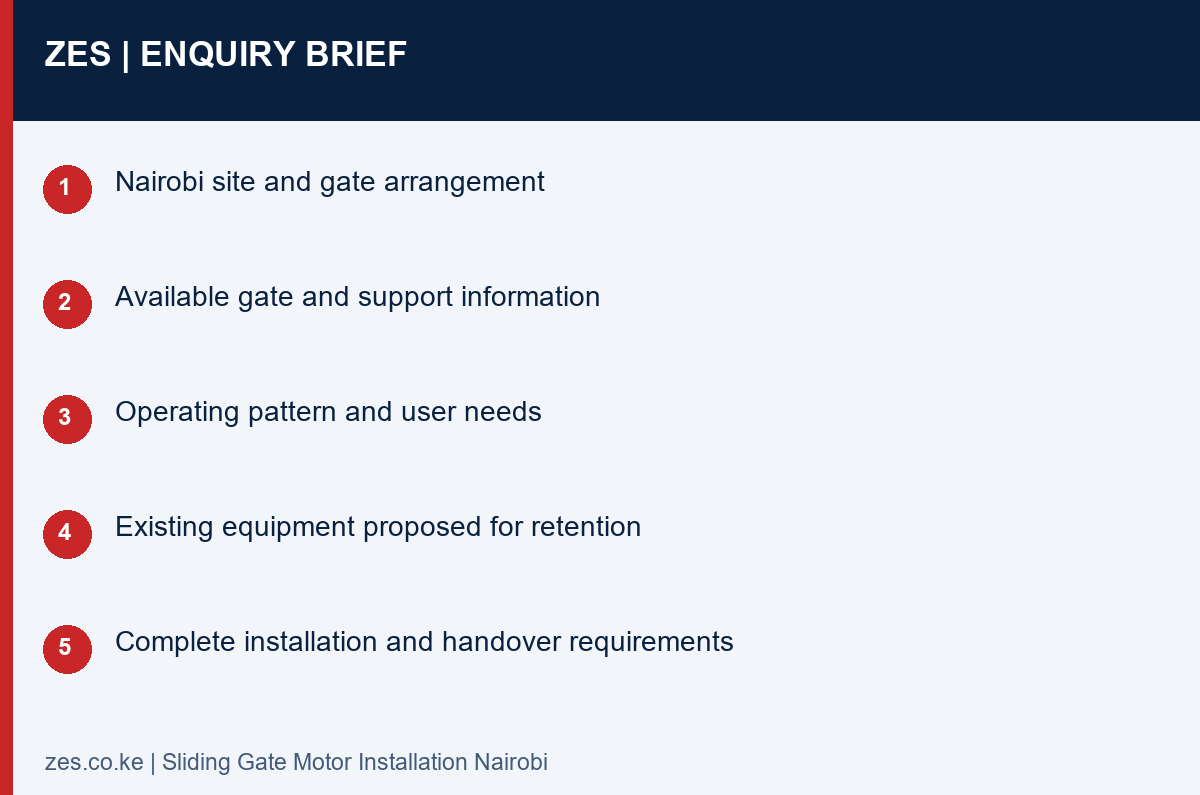
An existing sliding gate may be a suitable starting point, but its condition must be assessed. Track alignment, rollers, guide supports, stops and drainage all affect the work. Tell ZES whether you want to retain the current gate, repair it, or include fabrication in the quotation. These are different budgets and should not disappear into a single unexplained installation figure.
2. Confirm the usable opening and run-back area
The clear entrance width and the space beside it are separate measurements. A gate needs somewhere to travel without obstructing people, parked vehicles or other equipment. Share photographs showing the full opening and the side into which the gate retracts. Measurements you provide help prepare the enquiry; final equipment selection depends on site assessment.
3. Describe peak operating demand
A private home with occasional arrivals has a different usage pattern from an apartment block with a morning queue. Record the busiest period, not just the total daily vehicle count. Ask how the proposed sliding gate motor suits that demand and what assumptions the installer has made. A motor selected from gate weight alone may overlook the entrance’s actual work.
4. Compare Sliding Gate Motor Price Kenya quotations correctly
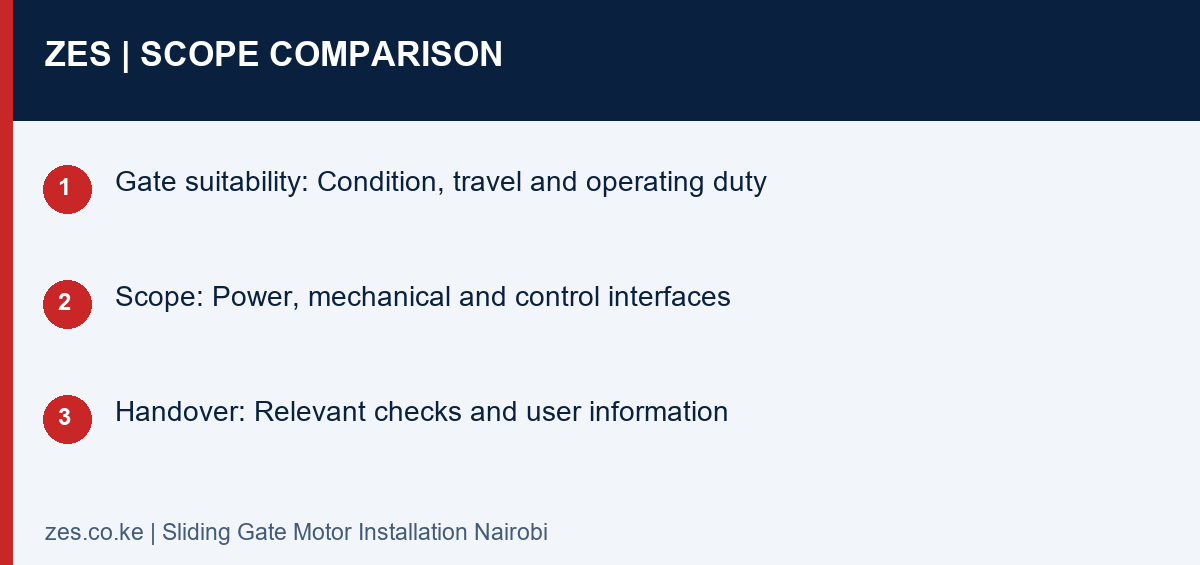
A sliding gate motor price may refer to the operator alone, a boxed kit, or an installed system. Ask which one the seller means. A complete quotation should identify the model, rack, controls, relevant protective devices, power work, mounting work, commissioning and any excluded repairs. Delivery, taxes and making good should also be clear. ZES provides a project quotation after the requirement is defined; this guide does not publish an unverified universal price.
| Price component | What to ask |
|---|---|
| Operator | Which exact model and what is included with it? |
| Mechanical work | Are track, roller or gate repairs included? |
| Power | Who provides the supply and what backup is proposed? |
| Controls | How many remotes and which other access methods? |
| Completion | What checks, instructions and support terms are included? |
5. Plan pedestrian movement separately
A vehicle entrance also attracts people walking in and out. Explain whether there is a separate pedestrian gate and where visitors wait. Ask the installer to assess the movement area and protective arrangements. Convenience features such as automatic closing must be considered with how the entrance is actually used. Do not treat a remote control as a substitute for entrance safety.
6. Decide who controls access
List the households, guards or facilities staff who need operating devices. Agree who approves new remotes and handles lost ones. If an intercom or existing access-control system is involved, name its model and explain the desired action. Compatibility and installation responsibility should be confirmed before accessories are ordered.

7. Define what a finished installation means
Request a demonstration of the agreed controls and operating modes, the user instructions and the actual support terms. Have the site contact present for handover. Record the installed model and any retained components. A clear handover helps the next service visit start from facts instead of guesses.
Request a sliding gate quotation
Send ZES the location, gate photographs, approximate opening width, current condition and busiest usage period. Mention whether fabrication, motor installation or motor replacement is required. For an itemised proposal, request a quotation or arrange a site survey. If the gate currently fails to open, use the repair guide to prepare the fault information first.
Further guidance for your entrance
Sliding gates are the most common automatic gate type in Kenya for good reason. They need less clearance than swing gates, they suit wide driveways, and they can be automated reliably with a rack-and-pinion motor. But a sliding gate is only as good as its motor, its track or cantilever structure, its safety devices and the quality of installation.
This guide explains everything you need to know about sliding gate motors and automatic sliding gates in Kenya: how they work, the types available, how to choose the right motor, how installation is done properly, how safety and access control are handled, how to maintain and repair the system, and how to avoid the mistakes that cause recurring faults.
It is written for homeowners, estate managers, developers, business owners and facility managers.
Why Choose a Sliding Gate?
Sliding gates have practical advantages over swing gates.
Less clearance. A sliding gate moves sideways along a track or cantilever, so it does not need space to swing open.
Wide entrances. Sliding gates suit wide driveways and commercial entrances better than swing gates.
Reliable automation. Rack-and-pinion motors are simple and reliable when installed correctly.
Security. A closed sliding gate presents a solid barrier.
Traffic flow. Sliding gates can open quickly and stay open for convoys.
Aesthetics. Sliding gates can be designed to suit the property.
Wind resistance. Sliding gates are less affected by wind than large swing leaves.
The trade-off is that sliding gates need a clear run area and proper support, which must be planned.
Types of Sliding Gates
Different sliding systems suit different sites.
Track Sliding Gates
The gate runs on rollers along a ground track. Track systems are common and cost-effective, but the track must be level, clear and well maintained. Debris and wear can cause binding.
Cantilever Sliding Gates
The gate is supported by a structure and does not need a ground track. Cantilever systems suit uneven ground, slopes and areas where a track would be impractical. They cost more but avoid track problems.
Telescopic Sliding Gates
The gate leaves slide and overlap to fit tight spaces where a full gate run is not available.
Bi-fold Sliding Gates
The gate folds as it opens, reducing the run length required.
Heavy-Duty Industrial Sliding Gates
Designed for factories, warehouses and high-security sites with heavy usage.
The right type depends on the space, ground conditions and usage.
How a Sliding Gate Motor Works
Most sliding gate motors use a rack-and-pinion system.
Motor. An electric motor with a gearbox drives a pinion gear.
Rack. A toothed rack is fixed along the gate. The pinion engages the rack to move the gate.
Controller. The control panel manages operation, limits, force and safety inputs.
Limits. Limit switches or encoders stop the gate at the correct positions.
Safety devices. Photocells, safety edges and sensors detect obstacles.
Manual release. A key release allows manual operation during power failure.
Remote controls. Handheld transmitters or other access devices operate the gate.
Understanding the system helps you maintain it and recognise faults.
Choosing the Right Sliding Gate Motor
Motor selection is critical.
Gate weight. The motor must be rated for the gate weight plus fittings.
Gate length. Longer gates place more load on the motor and structure.
Frequency of use. A home gate opens a few times a day; a commercial gate may open hundreds.
Duty cycle. The motor’s rated usage must match the demand.
Track or cantilever. The motor must suit the gate support method.
Environment. Dust, rain and heat affect motor life.
Safety margin. Choosing a motor slightly above the requirement improves reliability.
Brand and spares. Choose a motor with local support and spare parts.
Under-specifying the motor is the most common cause of early failure.
Components of an Automatic Sliding Gate
A complete system includes:
Motor and gearbox. The drive unit.
Rack. Fixed to the gate for the pinion to engage.
Rollers and guides. Support and guide the gate.
Track or cantilever structure. Supports the gate’s movement.
Controller. The control panel.
Safety devices. Photocells, safety edges and warning lights.
Access control. Remote controls, keypads, intercoms or tags.
Power supply. Mains, solar or backup.
Manual release. For power failure.
Housing. Protects the motor and controls.
Each component affects reliability and safety.
Site Assessment
A proper installation begins with assessment.
Gate condition. Is the gate suitable for automation?
Gate weight and length. Determines motor rating.
Ground conditions. Level, slope, drainage and track suitability.
Run space. Is there room for the gate to slide open?
Power availability. Mains, solar or backup.
Cable routes. How power and control cables will run.
Safety. Where pedestrians and vehicles move.
Access control. What devices are needed.
Environment. Dust, rain, trees and traffic.
Skipping assessment leads to the wrong motor and recurring problems.
The Installation Process
Professional installation follows a clear sequence.
1. Survey. Assess the gate, ground, power and access.
2. Design. Select the motor, support method and access control.
3. Quotation. Itemise equipment, labour, wiring and commissioning.
4. Preparation. Prepare the foundation, track or cantilever structure.
5. Mounting. Fit the motor, rack, rollers and guides.
6. Wiring. Run power and control cables safely.
7. Control installation. Fit the controller, receivers and safety devices.
8. Commissioning. Set limits, force, speed and safety functions; test thoroughly.
9. Training. Show the client how to operate, release and maintain the gate.
10. Handover. Provide documentation and support.
Poor commissioning is a common cause of faults and safety issues.
Safety Systems for Sliding Gates
Safety is the most important part of automation.
Obstruction detection. The gate should stop or reverse on contact.
Force limits. Set so the gate does not exert dangerous force.
Safety edges. Rubber or optical sensors on the gate.
Photocells. Detect vehicles or people in the path.
Warning lights. Flash before and during movement.
Emergency release. Manual release for power failure.
Safe-stop. The gate should stop safely rather than trap.
Signage. Warning signs on automated gates.
Testing. Test safety functions at commissioning and during maintenance.
A sliding gate can cause serious injury if safety is neglected.
Access Control for Sliding Gates
Modern gates integrate with access control.
Remote controls. Handheld transmitters for residents and staff.
Keypads. Code entry for visitors and staff.
Intercoms. Audio or video verification.
Biometrics. Fingerprint or face recognition.
Vehicle tags. Long-range tags for frequent users.
Mobile access. Smartphone apps.
CCTV integration. Cameras at the gate.
Visitor management. Logging and temporary access.
Access control should be designed with the gate.
Power and Backup
Reliable power is essential.
Mains power. Common in urban areas, but voltage fluctuations can affect motors.
Solar power. Suitable for remote or unstable-grid sites.
Battery backup. Allows operation during outages.
Manual release. Essential for safety and access.
Surge protection. Protects control boards.
Earthing. Protects equipment and users.
Isolation. For maintenance.
Power problems are a common cause of motor and controller failures.
Commissioning and Testing
Commissioning confirms the gate is safe and reliable.
Travel limits. Confirm open and closed positions.
Force settings. Set for safe reversal on obstruction.
Speed. Set for safe operation.
Safety devices. Test photocells, safety edges and lights.
Manual release. Confirm it works and the client knows how to use it.
Remote controls. Test range and operation.
Access control. Test intercoms, keypads and tags.
Power failure. Test backup and manual release.
Cycle test. Operate repeatedly to check reliability.
Handover. Train the client and provide documentation.
A gate that is not commissioned is not complete.
Maintenance of Sliding Gates
Regular maintenance prevents faults.
Track cleaning. Remove debris from the track.
Roller checks. Replace worn rollers.
Rack and pinion. Check alignment and lubrication.
Motor checks. Inspect for wear and overheating.
Controller checks. Verify settings and connections.
Safety testing. Test obstruction detection and release.
Battery checks. For backup and solar systems.
Cleaning. Keep the gate and track clear.
Records. Track maintenance and repairs.
Response. Choose a contractor with reliable support.
Maintenance extends life and protects safety.
Common Sliding Gate Motor Faults
Knowing the faults helps diagnosis.
Motor runs but gate does not move. Rack, pinion or coupling issue.
Gate moves slowly. Motor wear, binding or incorrect settings.
Gate reverses unexpectedly. Obstruction, safety device or force setting.
Motor stops and resets. Overheating or controller fault.
Gate does not close fully. Limit switch or obstruction.
Remote does not work. Battery, receiver or interference.
Motor runs continuously. Limit or controller fault.
Power failure. Battery or manual release.
Noise. Worn rollers, rack or motor.
Water ingress. Damaged housing or seals.
Professional diagnosis prevents replacing parts unnecessarily.
Repair versus Replace
Not every fault requires a new motor.
Repair is usually right when: the fault is a component, setting or wiring issue.
Replacement is usually right when: the motor is undersized, worn out or repeatedly failing.
Cost. Compare repair cost with replacement and expected remaining life.
Parts availability. Local spares make repair practical.
Upgrade. Sometimes a better motor solves recurring problems.
A good contractor will advise honestly.
What Affects Sliding Gate Motor Cost in Kenya
Cost depends on the system.
Motor rating. Heavier gates need stronger motors.
Gate type. Track and cantilever systems differ in cost.
Safety devices. Photocells and safety edges add cost.
Access control. Remote controls, intercoms and keypads add cost.
Power. Solar or backup systems add cost.
Wiring distance. Long runs increase cost.
Installation complexity. Ground conditions and access affect labour.
Maintenance. Ongoing servicing should be budgeted.
A good quotation itemises equipment, labour, wiring and commissioning.
How to Choose a Sliding Gate Contractor
Use this checklist.
1. Do they survey the site? Gate, ground and power.
2. Do they specify the motor rating? Matched to weight and usage.
3. Do they explain safety devices? Obstruction, edges and photocells.
4. Do they provide an itemised quotation? Transparent pricing.
5. Do they handle wiring and commissioning? Complete installation.
6. Do they offer access control? Remote, keypad and intercom.
7. Do they offer maintenance? Ongoing support.
8. Do they have references? Comparable installations.
9. Do they respond to faults? Reliable support.
10. Do they provide documentation? Manuals and warranty.
Common Mistakes in Sliding Gate Installation
Undersized motor. Early failure.
Poor track or foundation. Binding and strain.
No safety devices. Serious risk.
Incorrect force settings. Unsafe operation.
No manual release. Locked out during outages.
Poor wiring. Intermittent faults.
No surge protection. Controller failures.
Skipping commissioning. Limits and safety not set.
No maintenance. Gradual failure.
Choosing on price alone. Cheap installations cost more.
Rack and Pinion Setup and Adjustment
The rack and pinion transfer motor power to the gate.
Rack alignment. The rack must align with the pinion along the gate’s travel.
Rack height. The rack should be mounted at the correct height for the pinion.
Rack fixing. Fixings must be secure and spaced correctly.
Pinion engagement. The pinion should engage the rack fully without binding.
Wear. Worn racks or pinions cause noise and slipping.
Lubrication. Appropriate lubrication reduces wear.
Adjustment. The motor may need adjustment as the gate settles.
Inspection. Check alignment and wear during servicing.
Poor rack alignment is a common cause of motor strain and noise.
Track Installation and Drainage
Track systems need careful installation.
Foundation. The track foundation must be stable and level.
Track alignment. The track must align with the gate and motor.
Drainage. Water should not pool around the track.
Clearance. The gate must clear the track and ground.
Debris. The track should be easy to clean.
Wear. Rollers and tracks wear over time.
Cantilever alternative. Where drainage or ground conditions are poor, a cantilever system may be better.
Maintenance. Clean and inspect the track regularly.
Track problems are a common cause of binding and motor failure.
Motor Fault Codes and Diagnostics
Modern controllers report faults.
Fault codes. The controller displays codes for common faults.
Power faults. Check supply, fuses and protection.
Safety faults. A triggered photocell or safety edge prevents movement.
Limit faults. Incorrect limits stop the gate at the wrong position.
Motor faults. Overload, overheating or winding failure.
Battery faults. Low battery or charging failure.
Receiver faults. Remote control issues.
Diagnostics. A technician should interpret codes and test components.
Fault codes speed up diagnosis and reduce guesswork.
Sliding Gate Security Features
Automation must not weaken security.
Gate strength. The gate itself must resist forcing.
Locking. Motors and mechanical locks secure the gate when closed.
Anti-lift devices. Prevent the gate being lifted off its track.
Control security. Manage remotes and codes.
Access control. Restrict who can open the gate.
CCTV and lighting. Visibility at the gate.
Integration. Gate, intercom, CCTV and alarms working together.
Monitoring. Alerts for forced entry or faults.
Security is a combination of gate design, automation and management.
Frequently Asked Questions
How much does a sliding gate motor cost in Kenya?
Cost depends on the gate weight, motor rating, safety devices, access control, power and installation. Request an itemised quotation after assessment.
Which motor is best for a sliding gate?
The motor must be rated for the gate weight, length and frequency of use. Choose a reputable brand with local support and spares.
Can I automate my existing sliding gate?
Often yes, if the gate is in good condition and suitable for automation. The gate should be assessed first.
How long does installation take?
A typical residential installation can take a day or two; larger or complex systems take longer.
Do sliding gates work during power outages?
With battery backup or manual release, yes. A manual release is essential.
Are sliding gates safe?
They can be, when fitted with obstruction detection, safety edges, photocells and correct force settings.
How often should a sliding gate be serviced?
At least annually, and more often for heavy-use gates.
Why does my gate reverse unexpectedly?
It may be detecting an obstruction, a safety device may be triggered, or the force setting may be incorrect.
Can I open the gate from my phone?
Yes, with smart controllers and mobile access, configured securely.
Do you work outside Nairobi?
Yes. Installation and support can be arranged across Kenya.
A Final Pre-Purchase Checklist
Before installing a sliding gate motor, confirm the following. Make sure the gate and site have been assessed. Check the motor rating against weight and usage. Confirm the quotation itemises equipment, wiring, safety devices, commissioning and access control. Ask about power and backup. Confirm safety testing and manual release. Ask about maintenance and warranty. Check references. Finally, compare quotations against the same specification.
A contractor who explains these points clearly is usually the one worth trusting with your gate.
Conclusion
A sliding gate motor is the heart of an automatic sliding gate, but reliability depends on the whole system: the gate, the track or cantilever, the motor, the safety devices, the wiring and the commissioning.
If you are planning a sliding gate, start with the gate and the site. Then insist on the right motor, safety devices, proper commissioning and a maintenance plan.
ZES designs, installs and maintains sliding gate motors and automatic gates for homes, estates and businesses across Kenya. If you would like a practical assessment and a clear, itemised quotation, start with a site survey.
Request a sliding gate survey and quotation from ZES
Related Gate Automation Services
Explore our full gate and access-control capability:
- Electric gate motor installation and repair
- Automatic gate installation
- Automatic swing gates
- Sliding and swing gate automation
- Gate access control systems
- Automatic driveway gates
- Commercial automatic gate systems
- Solar powered automatic gates
- Automatic gate maintenance
- Automatic gate repair
- Gate welding and fabrication services
For product-specific information, consult the relevant manufacturer documentation, such as FAAC manuals or Centurion technical resources. Use the documentation for the installed model.
Related ZES gate guides
FAAC installation · Gate spare parts · Automatic gate prices · Request a quotation