
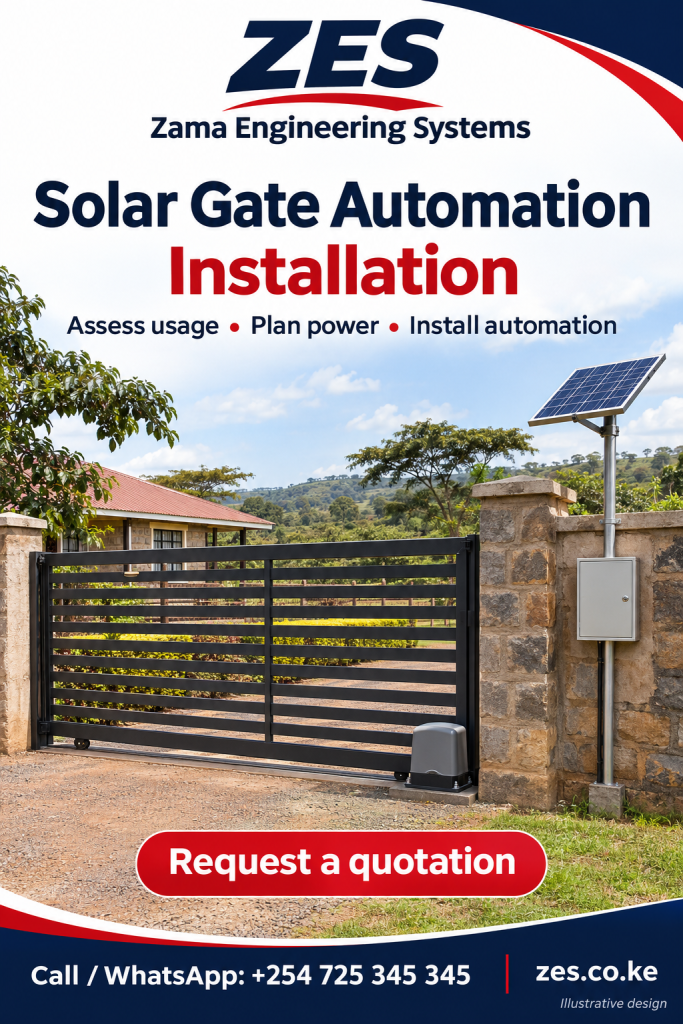
Solar Gate Automation Installation needs a power plan based on the gate’s actual use. A panel pictured beside a gate does not tell you whether the proposed system will meet your requirements. ZES can assess the entrance, operating demand and proposed equipment before defining the solar installation scope.
Solar Gate Automation Installation: 7 essential planning checks
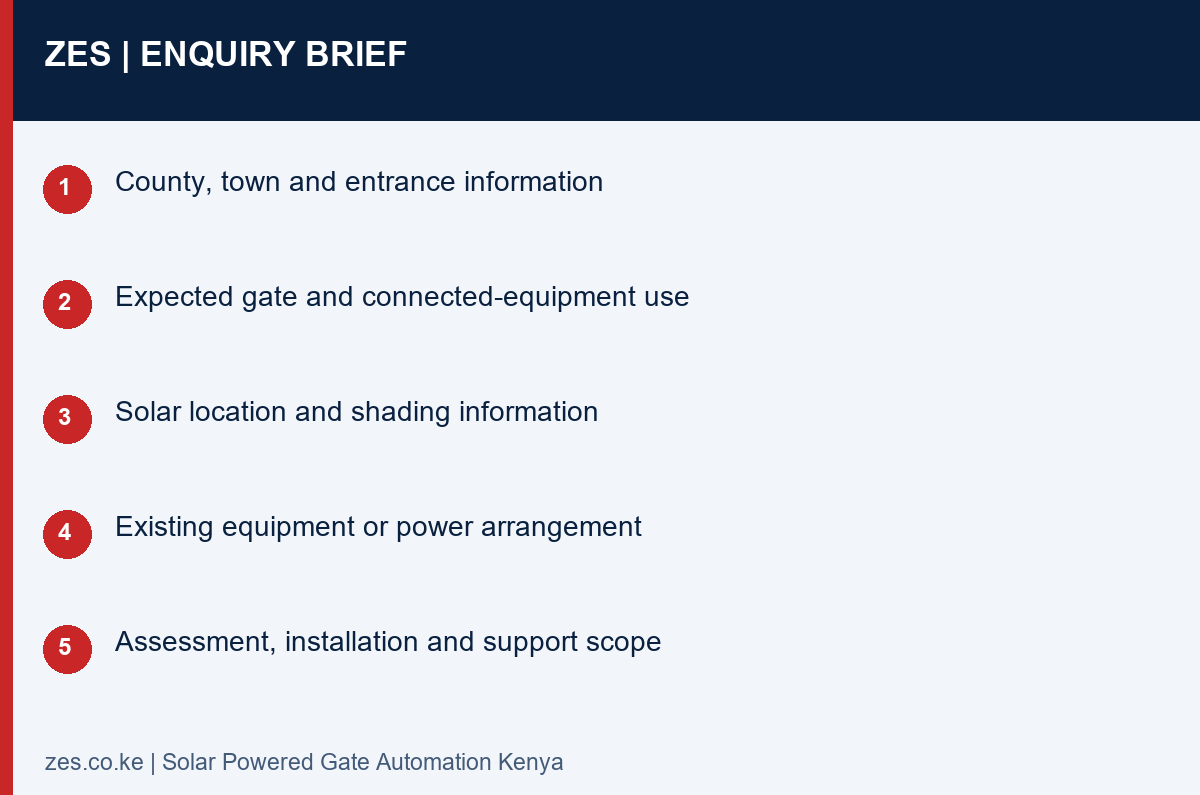
1. Explain why you want solar power
An off-grid entrance, an unreliable mains supply and a wish to reduce trenching are different starting points. Say which applies to the property. Ask whether the proposed arrangement is a complete off-grid system or another supported configuration. Do not assume those descriptions mean the same thing.
2. Describe usage and peak demand
Give the expected daily activity and busiest operating periods. Include visitors, deliveries and any planned growth in occupancy. The gate motor is not the only possible load: connected controls and accessories also need to be considered. A shared apartment gate should not be sized from the habits of one household.
3. Assess the panel location
Share photographs showing the entrance and likely mounting area. Trees, buildings, access for maintenance and physical security can affect the proposal. The installer should assess the position and mounting arrangements rather than select a panel solely from an advertised wattage.
4. Define realistic battery expectations
Explain how the entrance must operate during poor charging conditions and what alternative access arrangements exist. Ask for the assumptions behind the battery and charging proposal. Do not accept an unsupported promise of unlimited operation during bad weather. Battery condition and future replacement belong in the ownership plan.
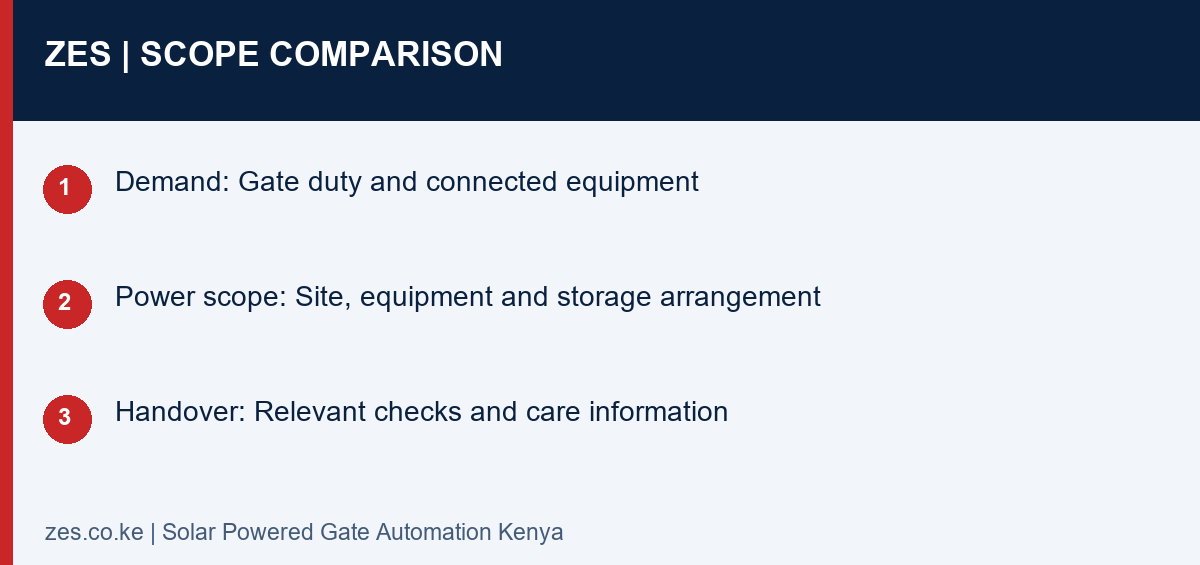
5. Confirm equipment compatibility
The operator, battery, charging equipment and connected devices need a supported arrangement. An existing gate may need changes before a solar proposal is suitable. Ask what is retained, what changes and who takes responsibility for the completed installation. A panel should not be treated as a universal accessory for any motor.
6. Compare the complete project cost
Ask for the gate automation equipment, solar and battery components, mounting, cabling, protection, labour, commissioning and exclusions to be stated. Clarify any site work or gate repairs. If you are comparing mains and solar options, compare both as complete installations with their expected maintenance needs.
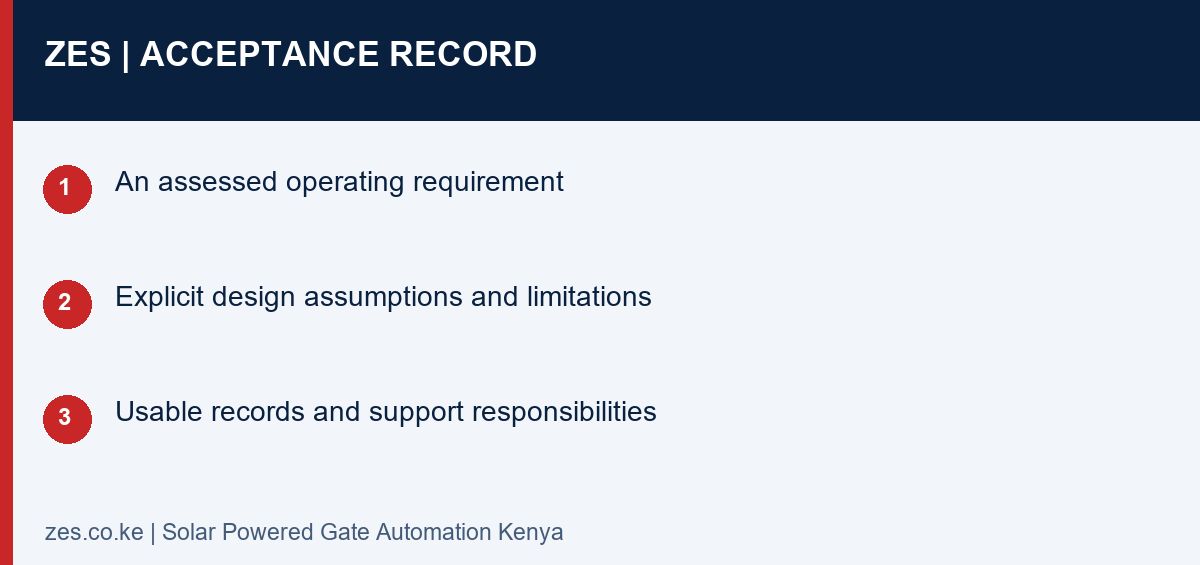
7. Agree handover and maintenance
The user should receive instructions for the installed arrangement, the equipment details and actual support terms. Ask what monitoring or routine owner observations are appropriate and when professional attention is needed. Record the battery and charging equipment so later service decisions use the correct specifications.
Can an existing gate be converted?
Possibly, subject to the existing operator, gate condition, usage and compatible power arrangement. Send ZES the known model and photographs. A site survey can establish what further assessment is needed. Do not buy a panel and battery on the assumption that all gate controllers support them.
Request a solar gate proposal
Contact ZES with the location, gate type, available supply, daily usage and reason for choosing solar. Mention whether the gate is new or already automated. ZES can discuss an assessed installation scope and quotation without inventing a universal package size.
Further guidance for your entrance
Mains power is not always available, reliable or affordable to extend. Remote homes, farms, lodges, gated plots and sites with unstable electricity still need secure, convenient entrances. Solar powered automatic gates solve that by generating and storing their own power.
But solar gate automation is not simply a panel bolted to a battery. It requires correct sizing, a suitable motor, proper charge control, battery protection and a manual release. Get it right and the gate works independently for years. Get it wrong and the gate fails on cloudy days, the battery dies early or the motor overheats.
This guide explains how solar powered automatic gates work in Kenya, the components and sizing, battery selection, installation, maintenance, what affects cost, and how to choose a contractor.
It is written for homeowners, farm and lodge owners, developers and facility managers.
Why Choose a Solar Powered Gate?
Solar gates offer practical advantages.
No mains connection. Sites without grid power can still have automatic gates.
Independence from outages. The gate keeps working during grid failures.
Lower running cost. After installation, the sun provides the energy.
Remote sites. Farms, lodges and plots far from power benefit most.
Faster deployment. No waiting for a power connection.
Security. A reliable gate improves security at remote properties.
Environmental benefit. Renewable energy powers the entrance.
The trade-offs are upfront cost, battery maintenance and careful sizing.
How Solar Gate Systems Work
A solar gate system has four main parts.
Solar panel. Converts sunlight into electricity.
Charge controller. Regulates charging and protects the battery.
Battery. Stores energy for use at night and on cloudy days.
Gate motor and controller. Operates the gate using stored energy.
The panel charges the battery during the day; the battery powers the motor and controller when needed. A well-designed system balances generation, storage and consumption.
Components of a Solar Gate System
A complete system includes:
Solar panel. Sized for the site’s sunlight and the gate’s energy use.
Mounting. Secure mounting with correct orientation.
Charge controller. Prevents overcharging and deep discharge.
Battery. Sized for nightly and cloudy-day operation.
Inverter or DC motor. Depending on the motor type.
Gate motor. Rated for the gate weight and usage.
Controller. Manages gate operation and safety.
Safety devices. Photocells, safety edges and warning lights.
Manual release. For emergencies and battery failure.
Housing. Protects electronics from weather and tampering.
Each component affects reliability.
Sizing a Solar Gate System
Correct sizing is essential.
Motor consumption. How much energy the motor uses per cycle.
Cycles per day. How often the gate opens and closes.
Standby consumption. Controllers and receivers use power continuously.
Sunlight hours. Average daily sunlight at the site.
Cloudy days. Days without sufficient sun that the battery must cover.
Battery depth of discharge. How deeply the battery can be discharged safely.
Panel capacity. Must cover daily consumption plus losses.
Safety margin. Extra capacity for cloudy periods and battery ageing.
Under-sizing is the most common cause of solar gate failure.
Battery Selection
The battery is the heart of a solar gate system.
Lead-acid batteries. Lower cost but shorter life and deeper discharge limits.
Lithium (LiFePO4) batteries. Longer life, deeper discharge and better efficiency, at higher cost.
Capacity. Sized for nightly and cloudy-day operation.
Temperature. Batteries perform differently in heat and cold.
Protection. Charge controllers protect against overcharge and deep discharge.
Maintenance. Some batteries need water checks; sealed and lithium types do not.
Replacement. Batteries have a limited life and should be budgeted.
A quality battery with proper protection lasts far longer.
Solar Panels and Mounting
Panel selection and mounting affect performance.
Panel size. Sized for the energy requirement and sunlight.
Orientation. Facing the direction of maximum sunlight.
Tilt. Adjusted for the site’s latitude and season.
Shading. Avoid shade from trees and buildings.
Mounting. Secure against wind and theft.
Cleaning. Dust reduces output; panels need periodic cleaning.
Cabling. Correct cable sizing and protection.
Protection. Surge and lightning protection where needed.
Good mounting and orientation improve reliability.
Gate Motor Selection for Solar
The motor must suit solar operation.
Efficiency. Efficient motors draw less energy.
Duty cycle. Rated for the gate’s usage.
Starting current. Some motors draw high current on start, stressing the battery.
DC motors. Often efficient for solar systems.
AC motors with inverter. Suitable where an inverter is used.
Manual release. Essential for battery failure.
Compatibility. With the controller and solar system.
The motor and solar system must be designed together.
Installation Process
Professional installation follows a sequence.
1. Survey. Assess the gate, sunlight, shading and usage.
2. Design. Size the panel, battery and motor.
3. Quotation. Itemise equipment, labour and commissioning.
4. Mounting. Install the panel and motor.
5. Wiring. Connect panels, controller, battery and motor safely.
6. Configuration. Set charge and discharge limits.
7. Commissioning. Test gate operation, charging and backup.
8. Training. Show the client how to operate, release and monitor.
9. Handover. Provide documentation and support.
Commissioning confirms the system performs as designed.
Safety Considerations
Solar gates need the same safety as mains gates.
Obstruction detection. The gate stops or reverses on contact.
Safety edges and photocells. Detect people and vehicles.
Force limits. Set to avoid dangerous force.
Warning lights. Flash before movement.
Manual release. Essential for battery failure and emergencies.
Signage. Warning signs on automated gates.
Battery safety. Batteries must be installed safely and protected.
Electrical safety. Wiring and connections must be safe.
Solar power does not remove the need for gate safety.
Maintenance
Solar gates need periodic care.
Panel cleaning. Dust and dirt reduce output.
Battery checks. Monitor voltage and capacity.
Controller checks. Verify settings and connections.
Motor servicing. Check operation and wear.
Safety testing. Test obstruction detection and release.
Wiring checks. Inspect for damage and corrosion.
Records. Track maintenance and battery replacement.
Support. Choose a contractor with solar experience.
Maintenance protects reliability and battery life.
What Affects Solar Gate Cost
Cost depends on the system.
Gate type and weight. Heavier gates need stronger motors.
Motor efficiency. Efficient motors reduce solar requirements.
Battery capacity and type. Lithium costs more but lasts longer.
Panel size. Larger panels cost more.
Mounting. Secure mounting and protection add cost.
Safety devices. Photocells and safety edges add cost.
Access control. Remotes, keypads and intercoms add cost.
Installation. Site access and wiring affect labour.
Maintenance. Battery replacement should be budgeted.
A good quotation itemises equipment, labour and commissioning.
How to Choose a Solar Gate Contractor
Use this checklist.
1. Do they design the system? Panel, battery and motor sizing.
2. Do they survey sunlight and shading? Site conditions matter.
3. Do they specify battery type and capacity? Reliability depends on it.
4. Do they explain manual release? Essential for battery failure.
5. Do they provide a clear quotation? Itemised and transparent.
6. Do they install safely? Electrical and battery safety.
7. Do they commission and test? Charging and gate operation.
8. Do they offer maintenance? Battery and panel care.
9. Do they have references? Solar gate installations.
10. Do they understand gates? Not just solar.
Common Mistakes
Under-sized panels. Battery never fully charges.
Under-sized batteries. Gate fails on cloudy days or at night.
Poor orientation or shading. Reduced charging.
Cheap charge controllers. Battery damage.
Wrong motor. Excessive current draw.
No manual release. Locked out when the battery fails.
Battery neglect. Early failure.
No safety devices. Serious risk.
Choosing on price alone. Cheap systems fail.
How to Size a Solar Gate System
Sizing is the difference between reliability and frustration.
Step one: motor energy use. Estimate how much energy the motor draws per cycle. The manufacturer’s data helps.
Step two: cycles per day. Count actual openings and closings, including guests and deliveries.
Step three: standby load. The controller, receiver and intercom draw power continuously. Include this.
Step four: sunlight. Estimate average daily sun hours at the site.
Step five: battery autonomy. Decide how many cloudy days the battery must cover, usually two to three.
Step six: panel size. Size the panel to cover daily consumption plus losses and battery ageing.
Step seven: safety margin. Add capacity for hot weather, dust and battery degradation.
Step eight: verify. Test the system over several days, including a cloudy period.
A system sized on guesswork will fail when the weather turns.
Battery Depth of Discharge and Cycle Life
Battery life depends on how it is treated.
Depth of discharge. The percentage of capacity used before recharging. Deeper discharge shortens life.
Lead-acid limits. Typically should not be discharged below about half their capacity.
Lithium limits. Can be discharged more deeply, often to 80–90%, with less damage.
Cycle life. The number of charge-discharge cycles before capacity drops significantly.
Temperature. Heat accelerates ageing, so batteries should be installed in a shaded, ventilated place.
Charge control. A quality controller prevents overcharge and deep discharge.
Replacement. Batteries are consumables and should be budgeted.
Choosing the right battery type and protecting it well is cheaper than frequent replacement.
Solar Panel Maintenance and Output
Panels need care to keep generating.
Dust and dirt. Reduce output, especially in dry seasons.
Bird droppings. Can shade cells and reduce output significantly.
Shading. New trees or buildings can shade the panel.
Cleaning. Periodic cleaning with water and a soft brush restores output.
Mounting. Check fixings after storms.
Cabling. Inspect for damage, corrosion and loose connections.
Controller. Check charge indicators and settings.
Output checks. Compare performance over time to detect problems.
Simple maintenance keeps the system performing.
Troubleshooting a Solar Gate
Most problems have predictable causes.
Gate does not move. Battery flat, controller fault, motor fault or obstruction.
Gate moves slowly. Low battery, motor wear or binding.
Battery not charging. Panel shaded or dirty, wiring fault or controller failure.
Battery drains quickly. Ageing battery, undersized system or excessive cycles.
Gate stops at midday. Overheating or controller protection.
Gate works in sun but not at night. Battery or charging problem.
Intermittent operation. Loose wiring or failing controller.
Remote not working. Remote battery or receiver issue.
Diagnosis should start with the battery and charging system.
Solar versus Mains: Total Cost Comparison
Both options have costs beyond the first invoice.
Mains connection. May require a transformer, cable trenching and utility fees, which can be substantial in remote areas.
Mains running cost. Electricity charges and possible voltage instability.
Solar upfront cost. Panels, controller, battery and installation.
Solar running cost. Minimal, but batteries need replacing.
Reliability. Solar is independent of grid outages; mains may need backup anyway.
Maintenance. Both need servicing, but solar adds battery and panel care.
Lifetime. Batteries are the main recurring cost.
Site suitability. Solar suits remote or unreliable-grid sites; mains is often cheaper where power is already available.
The right choice depends on the site and the total cost over time.
Frequently Asked Questions
How do solar powered gates work?
A solar panel charges a battery through a charge controller, and the battery powers the gate motor and controller.
Are solar gates reliable in Kenya?
Yes, when correctly sized for the site’s sunlight and usage. Kenya has good solar resources in most regions.
What happens on cloudy days?
A properly sized battery covers cloudy periods. Under-sized batteries cause failures.
How long do solar gate batteries last?
It depends on type and usage. Lithium batteries generally last longer than lead-acid. Replacement should be budgeted.
Can I convert an existing gate to solar?
Often yes, if the gate and motor are suitable. The system should be assessed and sized.
Do solar gates work at night?
Yes, using stored battery energy.
Is a manual release available?
Yes, and it is essential for battery failure and emergencies.
How much does a solar gate cost in Kenya?
Cost depends on gate type, motor, battery, panel and installation. Request an itemised quotation after a survey.
Do solar panels need cleaning?
Yes. Dust reduces output, so periodic cleaning is recommended.
Do you work outside Nairobi?
Yes. Installation and support can be arranged across Kenya.
A Final Pre-Purchase Checklist
Before installing a solar gate, confirm the following. Make sure the site’s sunlight and shading have been assessed. Check the panel, battery and motor sizing. Confirm the quotation itemises equipment, labour and commissioning. Ask about battery type and life. Confirm safety devices and manual release. Ask about maintenance and support. Check references. Finally, compare quotations against the same specification.
A contractor who explains these points clearly is usually the one worth trusting with solar gate automation.
Conclusion
Solar powered automatic gates in Kenya make secure entrances possible where mains power is unavailable or unreliable. The difference between reliable operation and constant failures is the sizing, the battery, the controller, the motor and the support.
If you are planning a solar gate, start with the sunlight, the usage and the gate. Then insist on correct sizing, quality components and a maintenance plan.
ZES designs, installs and maintains solar powered automatic gates for homes, farms, lodges and businesses across Kenya. If you would like a practical assessment and a clear, itemised quotation, start with a site survey.
Request a solar gate survey and quotation from ZES
Related Gate Automation Services
Explore our full gate and access-control capability:
- Electric gate motor installation and repair
- Automatic gate installation
- Sliding gate motors
- Automatic swing gates
- Sliding and swing gate automation
- Gate access control systems
- Automatic driveway gates
- Commercial automatic gate systems
- Automatic gate maintenance
- Automatic gate repair
- Gate welding and fabrication services
For product-specific information, consult the relevant manufacturer documentation, such as FAAC manuals or Centurion technical resources. Use the documentation for the installed model.
Related ZES gate guides
FAAC installation · Gate spare parts · Automatic gate prices · Request a quotation