
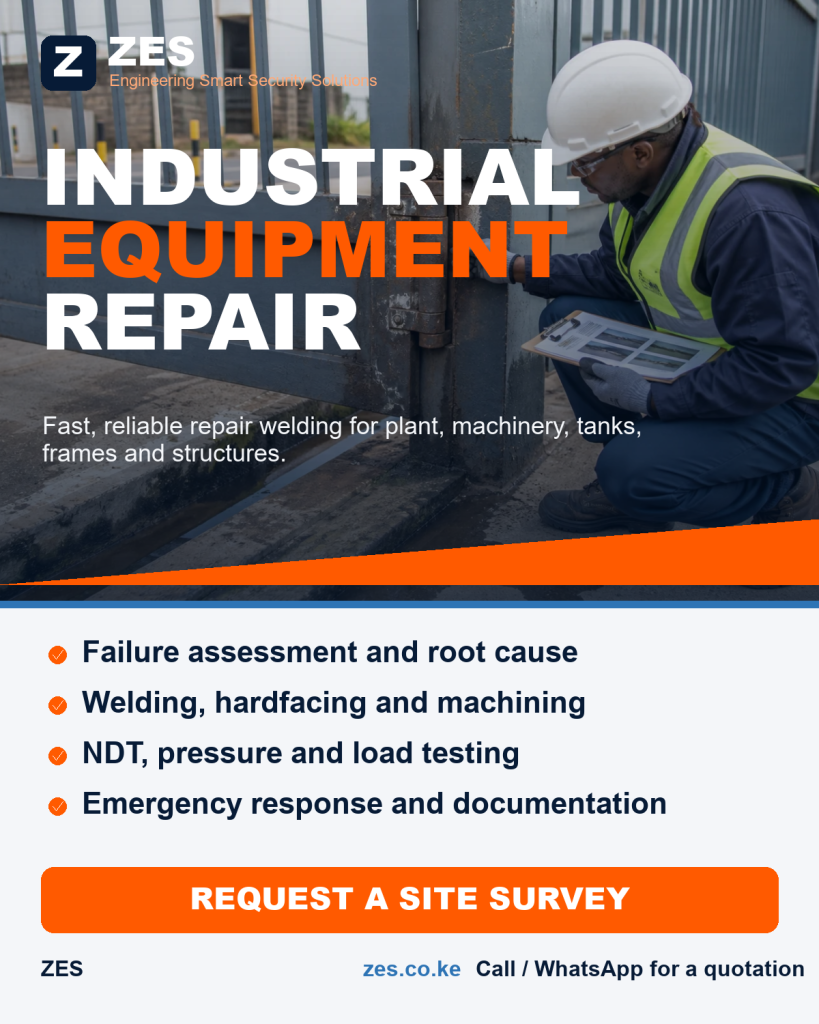
Equipment fails. Frames crack, shafts wear, tanks leak, chutes wear through, supports corrode and guards break. In an industrial plant, every hour of downtime is expensive, and replacement is not always practical or affordable. Repair welding restores equipment to service, extends asset life and keeps production running.
Request an equipment repair assessment
For a ZES quotation, share equipment identity, failure photographs, service conditions, previous repairs, available drawings and the permitted shutdown window. The team can then confirm the assessment, fabrication, site work and supporting specialists required for your project.
Ask the written proposal to identify materials, quantities, preparation, finishing, installation, inspection, exclusions and handover records. Any required welder qualifications, specialist tests or compliance documents must be confirmed for the actual scope before appointment.
Industrial equipment repair welding in Kenya is a specialist activity. It is not simply welding a crack shut. It requires understanding why the failure happened, selecting the right repair technique, matching materials, controlling heat and verifying the repair. A poor repair can fail again quickly — or worse, cause a safety incident.
This guide explains what industrial equipment repair welding involves, the common failures, how repairs are assessed, the techniques and materials used, how repairs are tested, how emergency and planned repairs are managed, what affects cost, and how to choose a contractor who can restore equipment safely.
It is written for maintenance managers, plant engineers, production managers, factory owners and operations directors.
What Industrial Equipment Repair Welding Covers
Repair welding covers a wide range of industrial equipment.
Frames and structures. Cracked frames, bent supports, broken brackets and failed welds.
Tanks and vessels. Leaking seams, corroded sections, nozzle repairs and support repairs.
Conveyors and chutes. Worn liners, cracked frames and damaged transfer points.
Shafts and components. Build-up of worn surfaces and repair of damaged parts.
Pipes and supports. Leaking welds, corroded sections and failed supports.
Machine bases and skids. Cracks, distortion and corrosion.
Guards and safety structures. Damaged guards and barriers.
Hoppers and silos. Wear, cracks and corrosion.
Platforms and walkways. Structural repairs and safety.
Tooling and jigs. Repair and modification.
The scope ranges from small component repairs to major structural restoration.
Why Repair Welding Is Specialist
Repair welding is more demanding than new fabrication.
Unknown history. The material, service history and cause of failure may be unclear.
Contamination. Equipment in service may be contaminated with oil, chemicals or product, affecting weld quality.
Access. Repairs often happen in awkward locations.
Downtime pressure. Repairs are often urgent, which increases risk.
Safety. Equipment may be hot, pressurised, energised or in a hazardous area.
Quality expectations. A repair must restore function and safety, not just look welded.
Root cause. Without understanding the cause, repairs repeat.
Documentation. Repairs should be recorded for future reference.
A specialist repair contractor brings assessment, technique and discipline.
Common Equipment Failures
Failures follow predictable patterns.
Fatigue cracking. Repeated loading causes cracks, often at welds or stress concentrations.
Wear. Abrasion, impact and friction wear surfaces and components.
Corrosion. Chemicals, moisture and cleaning attack steel.
Impact damage. Accidents and handling cause dents, bends and cracks.
Overload. Excessive loads cause deformation and failure.
Thermal damage. Heat causes distortion, cracking and property changes.
Poor original fabrication. Undersized or poorly welded components fail early.
Vibration. Loosens fasteners and causes fatigue.
Understanding the failure mode guides the repair.
Failure Assessment and Root Cause
Assessment is the most important step.
Visual inspection. Look for cracks, deformation, corrosion and wear.
Non-destructive testing. Detect hidden defects.
Material identification. Confirm the material to select matching filler.
Service history. Understand loads, cycles and environment.
Root cause analysis. Determine why the failure occurred.
Repair feasibility. Decide whether repair is practical.
Repair design. Plan the repair technique and materials.
Risk assessment. Identify safety hazards during repair.
Skipping assessment leads to repairs that fail again.
Repair versus Replace
Not every failed component should be repaired.
Repair is usually right when: the component is structurally sound, the failure is local, the material is repairable and the cost is well below replacement.
Replacement is usually right when: the component is extensively damaged, the material is unsuitable, the repair cannot restore strength, or the lead time for replacement is acceptable.
Whole-life cost. Consider how long the repair will last versus a new part.
Downtime. Sometimes replacement is faster.
Safety. If there is doubt about structural integrity, replace.
A good contractor will advise honestly.
Repair Techniques
Different failures require different techniques.
Crack repair. Stop the crack, prepare the joint, weld and inspect.
Wear build-up. Weld hardfacing or build-up material onto worn surfaces, then machine.
Section replacement. Cut out damaged sections and weld in new material.
Patch repair. Weld a patch over damaged areas, where appropriate.
Straightening. Heat and mechanical force to correct distortion.
Nozzle and fitting repair. Replace or repair connections.
Support repair. Replace or strengthen failed supports.
Hardfacing. Apply wear-resistant material to extend life.
The technique must suit the material, the failure and the service conditions.
Welding Processes for Repairs
Process selection depends on the material and situation.
Stick welding. Common for site repairs and thicker sections, especially in difficult conditions.
MIG/MAG. Fast and versatile for many repairs.
TIG. Precise, suitable for stainless and thin sections.
Flux-cored. Useful for site work and thicker material.
Hardfacing processes. Apply wear-resistant layers.
Preheat. Required for some steels to prevent cracking.
Post-weld heat treatment. Required for some materials and applications.
The wrong process or parameters can cause new failures.
Materials and Filler Selection
Matching materials is critical.
Base material identification. Confirm the steel grade.
Filler matching. Use filler compatible with the base material and service.
Dissimilar metals. Joining different materials requires careful selection to avoid corrosion or cracking.
Consumable storage. Keep consumables dry and within specification.
Certificates. Confirm filler properties.
Hardfacing materials. Selected for wear resistance.
Stainless. Match grade and use appropriate finishing.
Wrong filler can cause cracking, corrosion or premature failure.
Machining and Fit-Up
Repairs often require machining.
Build-up and machining. Weld material is added and then machined to size.
Alignment. Components must align correctly.
Tolerances. Respect the required dimensions.
Surface finish. Suitable for the function.
Balancing. Rotating components may need balancing.
Inspection. Check dimensions after machining.
Coordination. Machining may need to happen between welding stages.
Machining capability is part of a complete repair service.
Testing and Inspection
Repairs must be verified.
Visual inspection. Weld appearance and finish.
Dye penetrant. Surface-breaking defects.
Magnetic particle. Surface and near-surface defects.
Ultrasonic. Internal defects.
Radiographic. Internal weld quality.
Pressure testing. For tanks and vessels.
Load testing. For structural repairs.
Functional testing. Confirm the equipment works.
Documentation. Record tests and results.
Testing confirms the repair is safe and effective.
Emergency Repairs
Breakdowns require fast, safe response.
Assessment. Identify the failure and the safest temporary solution.
Temporary repair. Secure the situation and restore safe operation.
Permanent repair. Plan and execute a durable fix.
Root cause. Understand why the failure occurred.
Communication. Keep production informed.
Documentation. Record the repair and recommendations.
Preparedness. Pre-agree arrangements before emergencies occur.
Emergency repairs should not become permanent by neglect.
Planned Repairs and Shutdowns
Planned work is safer and more efficient.
Scope definition. List the repairs needed.
Planning. Schedule resources and materials.
Preparation. Pre-fabricate parts where possible.
Sequencing. Coordinate with other work.
Permits. Arrange in advance.
Inspection. Plan hold points and testing.
Commissioning. Test before production resumes.
Documentation. Record work and results.
Shutdowns are the best time for major repairs.
Safety in Repair Welding
Repair work carries significant hazards.
Hot work permits. Formal authorisation and fire precautions.
Isolation. Lock-out/tag-out for energy sources.
Confined spaces. Gas testing and rescue arrangements.
Working at height. Safe access and fall protection.
Fumes. Ventilation and respiratory protection.
Chemicals. Equipment may contain hazardous residues.
Lifting. Safe handling of heavy components.
Electrical safety. Isolated and protected equipment.
Emergency response. Clear procedures.
Safety must be planned before work begins.
What Affects Repair Welding Cost
Cost depends on the repair and conditions.
Type of repair. Simple welds cost less than major restoration.
Material. Stainless and special alloys cost more.
Access. Difficult locations increase labour.
Downtime pressure. Urgent work costs more.
Machining. Adds cost where required.
Testing. NDT and pressure testing add cost.
Documentation. Reports add value.
Mobility. On-site work adds logistics.
A good quotation explains what is included.
How to Choose a Repair Welding Contractor
Use this checklist.
1. Do they assess the failure? Root cause and feasibility.
2. Do they identify materials? Correct filler selection.
3. Do they explain the repair method? Technique and testing.
4. Do they have machining capability? For build-up and fit.
5. Do they test and inspect? NDT and functional testing.
6. Can they respond urgently? Emergency availability.
7. Do they work safely? Permits, isolation and PPE.
8. Do they document the repair? Records and recommendations.
9. Do they have relevant experience? Similar equipment.
10. Do they show comparable work? References.
Common Mistakes in Repair Welding
No root cause analysis. The same failure returns.
Wrong filler. Cracking or corrosion.
Poor preparation. Contamination and poor fusion.
No preheat. Cracking in some steels.
Skipping machining. Poor fit and function.
No testing. Defects go unnoticed.
Unsafe work. Hot work and confined spaces.
No documentation. Difficult to track and improve.
Choosing only on price. Cheap repairs fail again.
Repair Welding by Sector
Manufacturing: frames, machine bases, guards and components.
Food processing: stainless equipment, tanks and conveyors.
Petroleum: canopies, tank supports and structures.
Mining: heavy equipment, chutes and structures.
Construction: plant, formwork and structural repairs.
Warehousing: racking, mezzanines and handling equipment.
Energy: supports, frames and equipment.
Agriculture: machinery, silos and conveyors.
Each sector has specific requirements, and a good contractor adapts.
Flange, Shaft and Bearing Repairs
Rotating and connected components need careful repair.
Shaft wear. Often repaired by build-up welding and machining to size.
Keyways and splines. Worn keyways can be repaired by welding and re-machining.
Flanges. Damaged flange faces can be repaired or replaced.
Bearing seats. Worn bearing seats can be built up and machined.
Alignment. Shafts and couplings must align correctly.
Balancing. Rotating components may need balancing after repair.
Material concerns. Heat from welding can affect shaft properties.
Testing. Run-up and vibration checks confirm the repair.
Rotating equipment repairs require precision and care.
Hardfacing and Wear Protection
Wear is one of the most common causes of equipment failure.
Hardfacing. Applying a wear-resistant alloy to a surface.
Build-up. Restoring dimensions before hardfacing.
Chute and hopper liners. Replaceable wear plates.
Crusher and mill parts. Hardfacing extends life.
Conveyor components. Wear protection on high-wear areas.
Material selection. Matched to the wear mechanism.
Application. Welding parameters affect the result.
Machining. Sometimes required after hardfacing.
Hardfacing can significantly extend equipment life and reduce downtime.
Tank and Pipe Repair
Tanks and pipework require careful repair.
Leak repair. Identify the leak, isolate, clean and repair.
Corrosion repair. Cut out corroded sections and replace.
Nozzle repair. Replace or repair damaged connections.
Weld repair. Reweld failed seams and joints.
Purging. For stainless and hygienic pipework.
Pressure testing. Confirm the repair is leak-free.
Material matching. Maintain corrosion resistance.
Documentation. Record the repair.
Tank and pipe repairs must restore both integrity and safety.
Structural Repair of Frames
Frames carry loads and must be repaired properly.
Crack assessment. Determine the extent and cause.
Crack repair. Stop the crack and restore strength.
Section replacement. Replace damaged sections.
Reinforcement. Strengthen where loads have increased.
Alignment. Restore correct geometry.
Welding. Qualified procedures and welders.
Inspection. Verify the repair.
Load testing. Where appropriate.
Documentation. Record the work.
Structural repairs without engineering can be dangerous.
Repair Documentation and History
Records improve future decisions.
Repair record. What failed, why and what was done.
Materials and consumables. Traceability.
Testing results. Evidence of quality.
Drawings and photos. Visual records.
Recommendations. Follow-up and prevention.
Asset history. Cumulative record for the equipment.
Cost records. Support budgeting.
Review. Use records to plan replacements.
Repair history turns maintenance into a learning process.
Preventive Maintenance and Repair Planning
Repairs are cheaper when planned.
Inspection schedule. Regular checks for cracks, wear and corrosion.
Condition monitoring. Vibration, temperature and performance.
Critical spares. Keep parts that would stop production.
Repair budget. Allocate funds for planned repairs.
Contractor arrangements. Pre-agree response and rates.
Shutdown planning. Schedule major repairs.
Training. Staff should spot early problems.
Records. Track issues and trends.
Review. Improve the programme over time.
Prevention reduces emergencies and extends equipment life.
Wear Mechanisms Explained
Understanding wear helps select the right repair.
Abrasion. Hard particles rub against a surface, wearing it away.
Impact. Repeated impacts cause deformation and spalling.
Adhesion. Surfaces rub and transfer material.
Fatigue. Cyclic stress causes surface and subsurface cracks.
Corrosion. Chemical attack removes material.
Erosion. Fluid or gas carries particles that wear surfaces.
Cavitation. Bubble collapse damages surfaces in pumps and valves.
Fretting. Small movements between surfaces cause wear.
The repair and protection must match the wear mechanism.
Repairing Cast Iron and Difficult Materials
Some materials require special techniques.
Cast iron. Requires preheat and controlled cooling to avoid cracking.
High-strength steels. May need preheat and low-hydrogen consumables.
Stainless. Requires appropriate filler and finishing.
Aluminium. Requires specific processes and cleanliness.
Dissimilar joints. Require careful filler selection.
Contaminated surfaces. Must be cleaned before welding.
Pre-qualified procedures. Important for difficult materials.
Testing. Essential after repairs on difficult materials.
A contractor who treats all materials the same is a risk.
Repair Planning and Job Cards
A structured repair process improves outcomes.
Job card. Records the equipment, fault, method and materials.
Assessment notes. Findings from inspection.
Repair method. Technique, materials and parameters.
Safety arrangements. Permits and precautions.
Testing requirements. NDT and functional checks.
Sign-off. Confirmation of completion.
Recommendations. Follow-up and prevention.
History. Added to the asset record.
Job cards improve consistency and traceability.
Quality and Certification of Repairs
Repairs may need certification.
Welder qualification. Evidence of competence.
Welding procedure. Specification of the process.
Material certificates. Confirmation of filler and base material.
Inspection reports. Evidence of testing.
Pressure test certificates. For vessels and pipework.
Load test records. For structural repairs.
Certification. Where required by regulation or client.
Documentation. Provided on completion.
Certification supports safety, insurance and compliance.
Building a Repair Programme
A repair programme reduces emergencies.
Asset register. List critical equipment.
Inspection schedule. Regular checks.
Condition monitoring. Detect deterioration early.
Critical spares. Keep parts that stop production.
Contractor panel. Pre-qualified repair contractors.
Repair budget. Planned and contingency funds.
Shutdown plan. Major repairs scheduled.
Records. Track repairs and trends.
Review. Improve based on data.
A programme turns repair from crisis into control.
Frequently Asked Questions
What is industrial equipment repair welding?
It is the assessment, welding and restoration of failed industrial equipment, including frames, tanks, conveyors, shafts, supports and guards.
Can you repair cracked equipment frames?
Yes, after assessment. The repair must stop the crack, restore strength and address the cause.
Do you identify the cause of failure?
Yes. Root cause analysis helps prevent repeat failures.
Can you repair stainless steel equipment?
Yes, with appropriate processes, fillers and passivation.
Do you provide machining after welding?
Machining can be arranged for build-up, fit and finish.
How do you test repairs?
Through visual inspection, NDT, pressure testing, load testing and functional testing as appropriate.
Can you respond to emergencies?
Emergency response can be arranged, subject to availability.
Do you work on site?
Yes, on-site repairs can be carried out with proper safety arrangements.
Do you provide documentation?
Yes. Repair records, test results and recommendations can be provided.
Do you work outside Nairobi?
Yes. Services can be provided across Kenya.
A Final Pre-Purchase Checklist
Before engaging a repair welding contractor, confirm the following. Make sure they assess the failure and cause. Check their material identification and filler selection. Confirm the repair method and testing. Ask about machining and fit. Confirm safety arrangements. Ask about documentation and recommendations. Confirm emergency capability. Ask for references. Finally, compare quotations against the same scope and quality requirements.
A contractor who explains these points clearly is usually the one worth trusting with critical equipment.
Conclusion
Industrial equipment repair welding in Kenya restores plant and machinery when failure threatens production. The difference between a repair that lasts and one that fails again is the assessment, the material selection, the technique, the testing and the root-cause understanding.
If equipment has failed, start with a proper assessment. Then insist on the right repair method, testing and documentation.
ZES provides industrial equipment repair welding, machining support, testing and maintenance for factories and plants across Kenya. If you would like a practical assessment and a clear, itemised quotation, start with a site visit.
Request an equipment repair assessment and quotation from ZES
Related Welding Services
Explore the rest of our welding and fabrication capability: